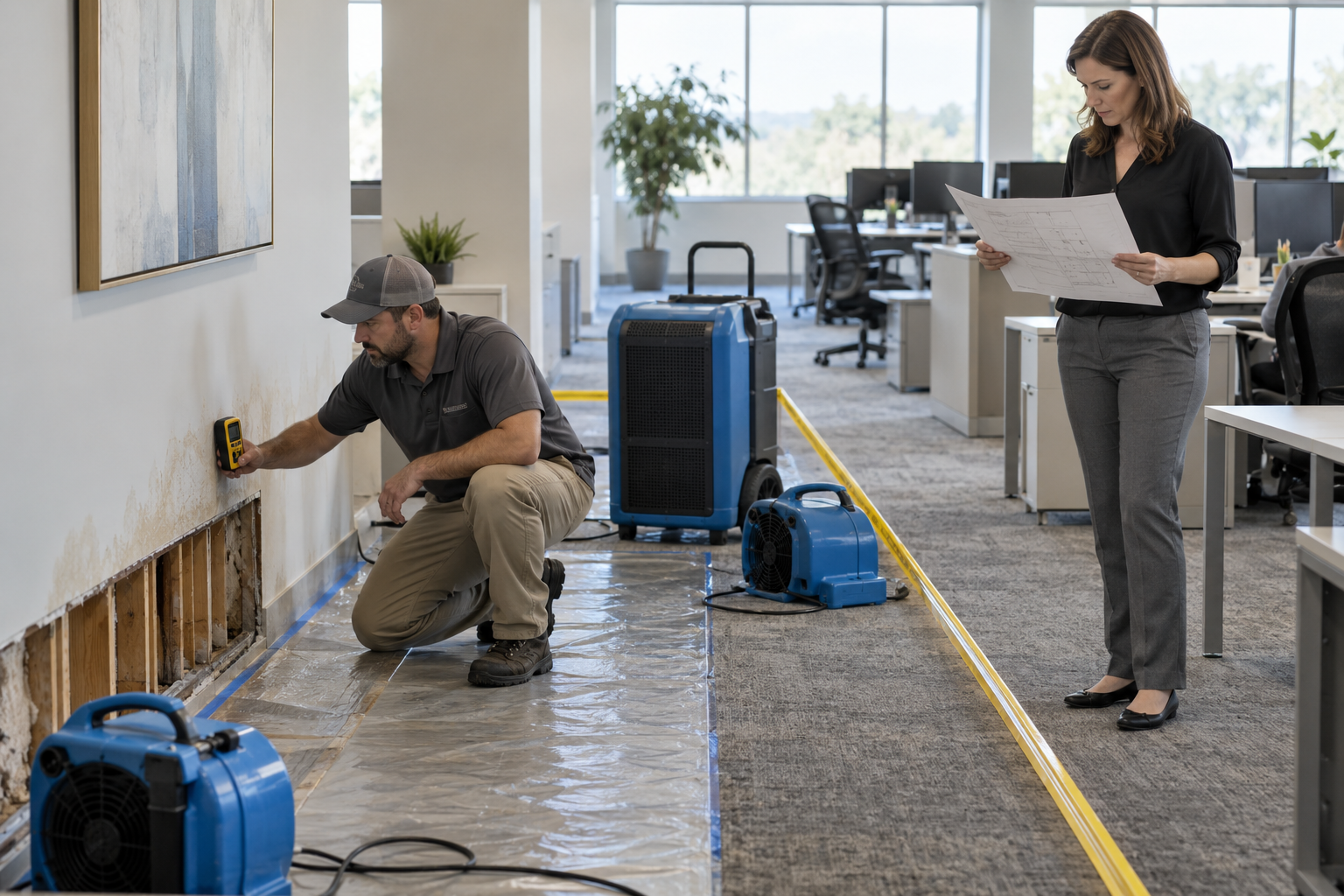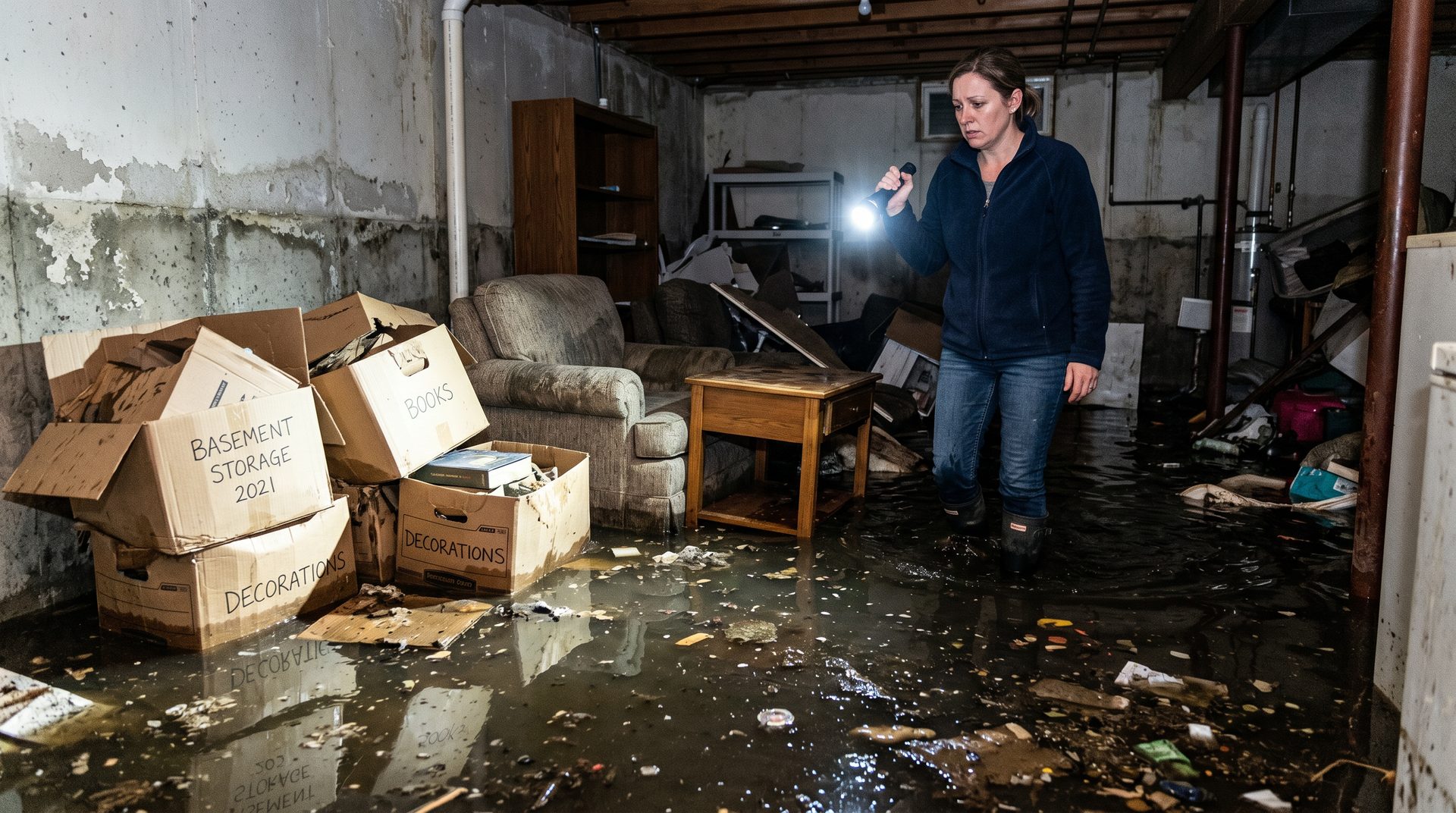
Quick Answer:Basement flooding in Calgary is caused by six main sources: sewer backup, foundation seepage, window well overflow, burst pipes, appliance failures, and spring snowmelt. The correct response — and which insurance coverage applies — depends on which cause is at play. Professional extraction and drying equipment must be deployed within hours to prevent mold growth.
Basement water damage is the single most common property insurance claim in Canada. Calgary's combination of clay-heavy soils, spring snowmelt, aging sewer infrastructure, and Chinook freeze-thaw cycles makes it one of the highest-risk cities in the country for basement flooding events.
The Six Causes of Basement Flooding in Calgary
The cause of your basement flooding determines the correct remediation protocol, the health risk, and which insurance coverage applies. Getting this identification right at the start prevents claim denials and incomplete remediation.
1. Sewer Backup
Sewer backup is water and sewage entering through floor drains, toilets, or fixtures connected to the sanitary drainage system. It is caused by a blockage in your sewer lateral (root intrusion, pipe collapse, joint offset) or by surcharging of the municipal sewer main during heavy rain in combined-sewer areas. Sewer backup water is IICRC Category 3 — grossly contaminated. All porous materials that have contacted the water must be removed. This is not a job for household cleaning products and a wet-vac. Our team provides complete sewage backup cleanup following IICRC S500 and S520 protocols.
2. Foundation Seepage
Calgary's clay soils generate significant hydrostatic pressure against foundation walls when wet. Older homes with minor cracks that have been stable for years can suddenly begin seeping during an unusually wet spring. Chronic seepage creates persistent moisture behind finishes and progressive mold colonization in wall cavities.
3. Window Well Overflow
Window wells fill faster than their gravel drainage layer can accept during heavy rain or rapid snowmelt. Once the water level rises above the window, it enters the basement at significant volume. Window well covers and improved drainage tile at the base of the well are the most effective preventive measures.
4. Burst Pipes
Calgary's Chinook climate creates temperature swings of 20–30°C within 24 hours. Supply lines in exterior walls freeze and then thaw rapidly — the burst typically occurs during the thaw, not during the coldest temperatures. Polybutylene pipe installed in homes from the late 1970s through mid-1990s is particularly failure-prone. A pipe that ran overnight can saturate an entire basement. See our guide on 24-hour water damage restoration for why response time is the critical factor.
5. Appliance Failures
Water heaters, washing machines, and dishwashers are consistently among the top causes of residential water damage claims. In basement mechanical rooms, a water heater failure discharges its full contents — 180–270 litres — before anyone notices.
6. Spring Snowmelt
Spring is Calgary's highest-risk season. Large volumes of meltwater run off frozen ground toward structures, overwhelming drainage systems on low-lying lots. The City of Calgary recommends maintaining a minimum 5% slope away from the foundation and ensuring downspouts discharge at least 1.8 metres from the home.
Calgary's Basement Flooding Support Program
The City of Calgary has historically operated subsidy programs to help homeowners reduce sewer backup risk — primarily by subsidising backwater valve installation. A backwater valve installed in the main sewer drain line automatically closes when it detects backflow from the municipal system, preventing sewage from entering through floor drains and low-lying fixtures.
Program details — eligibility, subsidy amounts, application processes — change based on annual budget decisions. Check the current program status directly at the City of Calgary's website or call 311. Installation cost before subsidy is typically $800–$2,000 for a licensed plumber on a straightforward installation.
For neighbourhoods served by combined sewer systems, the City is also undertaking long-term capital projects to separate storm and sanitary flows — reducing combined sewer surcharging events. These projects progress neighbourhood by neighbourhood over many years. In the interim, backwater valve installation remains the most reliable homeowner-level protection against sewer backup flooding.
Insurance Coverage: Three Types, Three Different Protections
Not all basement flooding is covered by the same policy, and standard homeowners insurance has historically excluded several types of water damage entirely. Understanding the three coverage categories before you have a claim is essential.
| Coverage Type | What It Covers | Included in Standard Policy? | Notes |
|---|---|---|---|
| Sudden & Accidental | Burst pipes, appliance failures, supply line breaks | Yes — standard property coverage | Must be sudden, not a known ongoing leak |
| Sewer Backup | Damage from sewage entering through drains or fixtures | No — requires separate endorsement | Most common and expensive claim type in Calgary; relatively modest annual premium to add |
| Overland Water | Surface water flowing overland into a home | No — requires separate endorsement | Newer product in Alberta market; some properties not eligible due to floodplain location |
Foundation seepage from ongoing hydrostatic pressure is generally not covered — it is considered a maintenance issue rather than an insured event. If you do not know whether your policy includes sewer backup coverage, call your broker today and ask specifically. For more context on how insurance applies in different flood scenarios, see our flood damage cleanup service page.
Average Costs of Basement Flooding Restoration in Calgary
Costs vary widely based on the cause, volume of water, water category, affected materials, and whether mold remediation is required.
| Event Scale | Description | Typical Cost (CAD) |
|---|---|---|
| Minor | Small supply line leak caught within hours; 10–20 m² of flooring, no wall saturation | $2,000–$5,000 |
| Moderate | Water heater or appliance failure; significant floor area, wall saturation requiring partial drywall removal | $5,000–$12,000 |
| Major | Burst pipe that ran overnight, or sewer backup requiring Category 3 remediation of finished basement | $12,000–$30,000+ |
Insurance deductibles for water damage claims in Alberta are commonly $1,000–$5,000. Sewer backup claims often carry higher deductibles — sometimes $2,500–$5,000 — reflecting the higher frequency and cost of these events. For guidance on choosing a restoration provider, see our guide to restoration companies in Calgary.
What to Do the Moment You Find a Flooded Basement
The sequence in the first 15 minutes significantly affects both safety and outcome. Follow this order precisely:
- Check electrical safety first. Do not enter the flooded area if water is near electrical outlets, junction boxes, or your panel. If the panel is in the flooded basement and you cannot safely reach it, call ENMAX (403-514-6100) or FortisAlberta for a free emergency meter disconnect — available 24/7.
- Stop the water source if it is supply-side. Main water shut-off is typically in the mechanical room. Turn clockwise to close. If the flooding is sewer backup (sewage smell, discoloured water through drains), do not try to flush or drain — evacuate the affected area.
- Document before touching anything. Take a full phone video walkthrough capturing waterline heights, standing water depth, affected contents, and visible structural concerns. Do not dispose of any contents before the adjuster or restoration crew has assessed them.
- Call professional restoration immediately. Do not run household fans overnight. Do not use a wet-vac as your primary response. The moisture inside wall cavities, under the subfloor, and inside insulation — invisible on the surface — is what becomes mold. Our emergency restoration service is available 24/7.
What Not to Do After Basement Flooding
The most common errors Calgary homeowners make that increase damage and complicate insurance claims:
- Running fans without dehumidification — spreads moisture-laden air to unaffected areas; slows drying rather than accelerating it
- Disposing of contents before documentation — eliminates insurance claim evidence; items not documented cannot be claimed
- Cleaning up sewer backup with household disinfectants — inadequate for IICRC Category 3 contamination; creates false confidence about surface safety
- Starting reconstruction before drying is confirmed — closing up wall cavities before moisture readings confirm dryness traps residual moisture and creates mold behind new materials within months
- Waiting until business hours to call — every hour of delay is measurable additional damage and mold risk
Proper drying is confirmed by calibrated moisture meters showing wood below 16% moisture content — not by visual inspection or touch. If a flooding event appeared to be dried but mold symptoms appear (musty odour, visible spotting, respiratory irritation), contact our mold remediation team before any reconstruction proceeds.
Mold Risk After Basement Flooding
Every basement flooding event carries mold risk that is not eliminated by visible drying. The mold germination window opens at 48–72 hours in saturated organic materials — drywall paper, wood framing, OSB subfloor, cardboard, dust accumulation. Professional drying dramatically reduces this risk when deployed promptly, but only when materials are confirmed dry by calibrated moisture meters.
Warning signs of mold after a flooding event:
- Musty odour that persists after drying is supposedly complete
- Visible dark spotting on drywall, studs, or joists
- Unexplained respiratory irritation in occupants
If any of these signs appear — even after a seemingly adequate dry-out — a professional mold assessment is warranted before any reconstruction proceeds. Installing new drywall over mold-affected framing traps the problem inside the wall, where it continues growing and eventually requires far more extensive remediation. See our resource on mold removal after water damage for what complete remediation looks like.
Long-Term Prevention for Calgary Homeowners
Highest-value preventive measures, in order of cost-effectiveness:
- Install a backwater valve if you do not have one — protects against the most expensive claim type in Calgary
- Replace rubber washing machine hoses with braided stainless steel
- Replace polybutylene supply lines if your home was built between 1978–1995
- Install a sump pump with battery backup — the battery backup is critical, as sump pump failure is most likely during the same storm event that causes flooding, when power outages are probable
- Maintain proper grade around the foundation (5% minimum slope away from the home)
- Ensure downspouts discharge at least 1.8 metres from the foundation
- Clear window wells of debris and check drainage before each spring melt
Know your insurance coverage before you need it. Call your broker and ask specifically whether you have sewer backup coverage, overland water coverage, and what your deductible is for each. Sewer backup endorsement annual premiums are typically $50–$150 — modest against the potential claim value. For more resources on the full scope of water damage restoration in Calgary, visit our dedicated resource page.
Frequently Asked Questions
Is basement flooding covered by standard Alberta homeowners insurance?
It depends on the cause. Burst pipes and appliance failures — sudden and accidental damage — are typically covered under standard policy property coverage. Sewer backup requires a separate endorsement. Overland flooding requires a further separate endorsement. Foundation seepage from ongoing hydrostatic pressure is generally not covered as it is considered a maintenance issue. Review your specific policy and speak with your broker to understand what coverage you have.
How long does basement flood restoration take?
The structural drying phase typically takes 3–5 days for promptly addressed clean-water flooding, and 7–10 days or longer for larger or delayed-response events. Reconstruction — replacing drywall, flooring, insulation, and any structural components removed — adds 1–4 weeks depending on scope and contractor availability. A modest flooding event can often be fully resolved within 2–3 weeks. A major event with mold remediation can take 6–8 weeks from event to complete restoration.
Can I stay in my home during basement flood restoration?
In most cases, yes — the work is confined to the affected basement area. Exceptions apply when the flooding involves sewage contamination that has migrated beyond the basement, when structural damage creates safety concerns, or when equipment volume and noise makes living there impractical. Your restoration contractor will advise at the initial assessment, and your insurance policy's additional living expenses (ALE) coverage provides hotel and meal costs if temporary relocation is required.
What is the City of Calgary's Basement Flooding Support Program?
The City of Calgary has periodically offered subsidy programs for homeowner installation of backwater valves and flood protection measures. Program details — subsidy amounts, eligibility criteria, application processes — change based on annual budget decisions. The most current information is available from the City of Calgary website or by calling 311. The program's purpose is to reduce sewer backup claim frequency in high-risk areas by helping homeowners install protective devices.
How do I know if my basement flooding was sewer backup or a burst pipe?
Key indicators: sewer backup water is typically dark or discoloured, has a sewage odour, and enters through floor drains, toilets, or drain fixtures. Burst pipe water is typically clear (if from a clean supply line), has no odour, and appears to come from the ceiling, walls, or a specific plumbing connection. Foundation seepage typically appears as water weeping through cracks in the foundation wall or emerging from the floor-wall joint. In ambiguous cases, a professional assessment using moisture meters and CCTV drain inspection identifies the source definitively — which matters both for appropriate remediation and correct insurance claim categorisation.
Calgary Restoration has responded to basement flooding across Calgary for years — sewer backups, burst pipes, spring melt events, foundation seepage, and everything in between. Do not guess at the cause or the solution. Contact Calgary Restoration immediately — we respond 24 hours a day and arrive equipped to handle every type of basement flooding Calgary experiences.
Easy steps to create a color palette
Lorem ipsum dolor sit amet, consectetur adipiscing elit lobortis arcu enim urna adipiscing praesent velit viverra sit semper lorem eu cursus vel hendrerit elementum morbi curabitur etiam nibh justo, lorem aliquet donec sed sit mi dignissim at ante massa mattis.
- Neque sodales ut etiam sit amet nisl purus non tellus orci ac auctor
- Adipiscing elit ut aliquam purus sit amet viverra suspendisse potent
- Mauris commodo quis imperdiet massa tincidunt nunc pulvinar
- Excepteur sint occaecat cupidatat non proident sunt in culpa qui officia
What is a color palette?
Vitae congue eu consequat ac felis placerat vestibulum lectus mauris ultrices cursus sit amet dictum sit amet justo donec enim diam porttitor lacus luctus accumsan tortor posuere praesent tristique magna sit amet purus gravida quis blandit turpis.

Don’t overspend on growth marketing without good retention rates
At risus viverra adipiscing at in tellus integer feugiat nisl pretium fusce id velit ut tortor sagittis orci a scelerisque purus semper eget at lectus urna duis convallis porta nibh venenatis cras sed felis eget neque laoreet suspendisse interdum consectetur libero id faucibus nisl donec pretium vulputate sapien nec sagittis aliquam nunc lobortis mattis aliquam faucibus purus in.
- Neque sodales ut etiam sit amet nisl purus non tellus orci ac auctor
- Adipiscing elit ut aliquam purus sit amet viverra suspendisse potenti
- Mauris commodo quis imperdiet massa tincidunt nunc pulvinar
- Adipiscing elit ut aliquam purus sit amet viverra suspendisse potenti
What’s the ideal customer retention rate?
Nisi quis eleifend quam adipiscing vitae aliquet bibendum enim facilisis gravida neque euismod in pellentesque massa placerat volutpat lacus laoreet non curabitur gravida odio aenean sed adipiscing diam donec adipiscing tristique risus amet est placerat in egestas erat.
“Lorem ipsum dolor sit amet consectetur adipiscing elit, sed do eiusmod tempor incididunt ut labore et dolore magna aliqua enim ad minim veniam.”
Next steps to increase your customer retention
Eget lorem dolor sed viverra ipsum nunc aliquet bibendum felis donec et odio pellentesque diam volutpat commodo sed egestas aliquam sem fringilla ut morbi tincidunt augue interdum velit euismod eu tincidunt tortor aliquam nulla facilisi aenean sed adipiscing diam donec adipiscing ut lectus arcu bibendum at varius vel pharetra nibh venenatis cras sed felis eget.