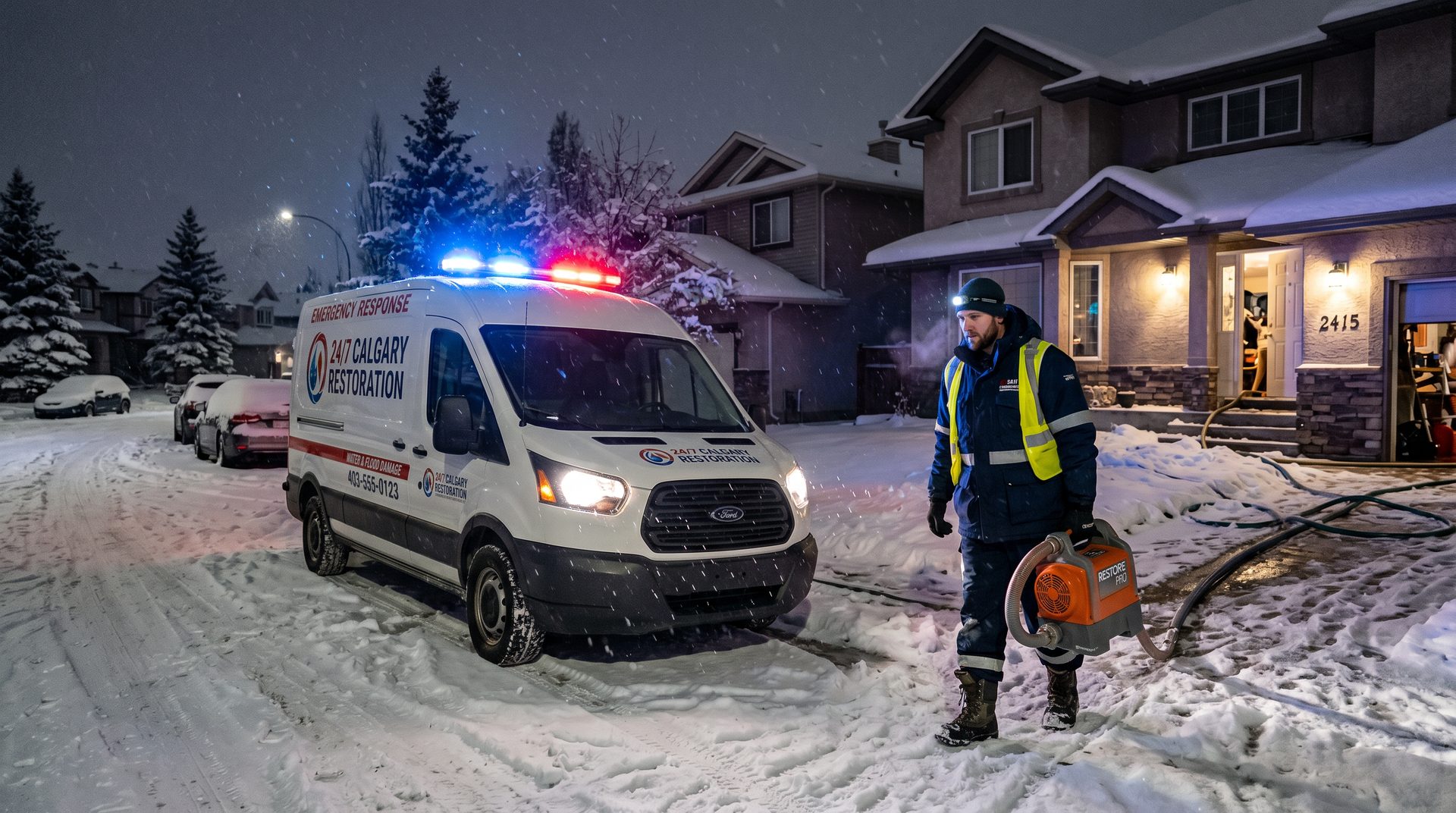
When a pipe bursts at 2 a.m. in a Calgary winter, every minute without professional extraction adds to your damage total. Calgary Restoration provides genuine 24/7 emergency water damage response — live dispatch, crews mobilized immediately, equipment on site within hours.
Quick Answer:Calgary Restoration dispatches live crews 24 hours a day, 7 days a week. When you call our emergency line, a dispatcher answers immediately and mobilizes a certified crew. Our target response time across Calgary is two hours or less.
Why 24/7 Response Is a Necessity in Calgary
Calgary's climate creates more after-hours water emergencies than most Canadian cities. Freeze-thaw cycles, chinook warm-ups of 20°C in hours, and spring snowmelt in March and April combine to overwhelm drains, burst pipes, and flood basements across neighbourhoods like Ramsay, Bowness, and Forest Lawn — at any hour.
The IICRC S500 Standard is clear on why timing matters:
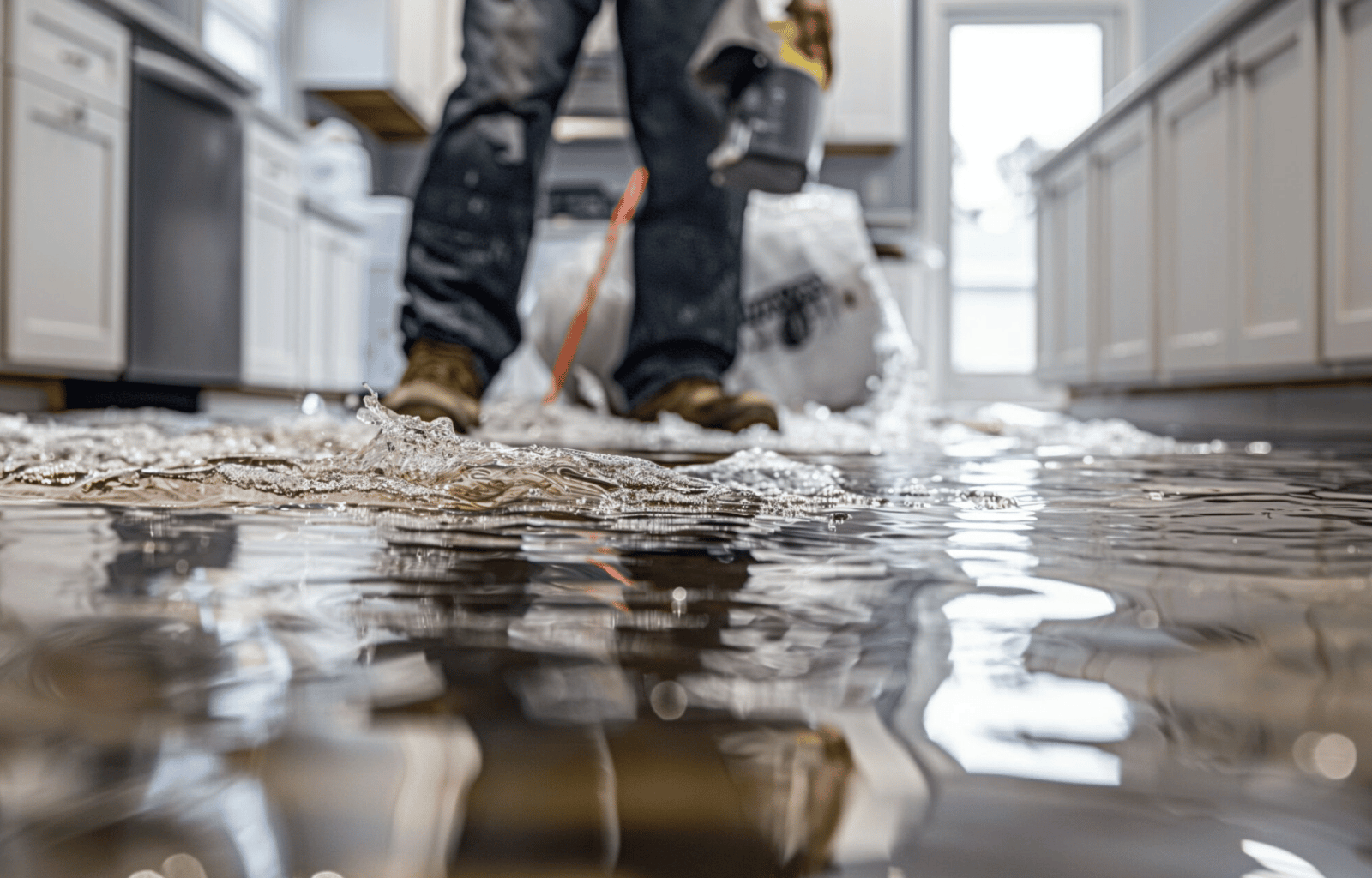
- Within 1 hour: Clean water begins wicking into drywall and subfloor materials
- Within 24–48 hours: Microbial growth can begin on wet organic surfaces in warm conditions
- After 72 hours: A burst pipe event can escalate to a mold remediation project costing 3–4× more
Many companies list a 24/7 number but route calls to voicemail after hours. True 24/7 service means a live dispatcher answers, a crew is mobilized, and extraction equipment is on site within a window measured in hours — not the next morning.
What to Do in the First 15 Minutes
Before the restoration crew arrives, these steps reduce damage and keep you safe:
- Shut off the water supply at the main valve (typically in the mechanical room near the water meter). This stops burst-pipe sources immediately.
- Turn off electricity to all circuits in the affected area at the breaker panel. Do not enter standing water near live baseboard heaters or outlets.
- Document with photos and video before moving anything. Your insurance adjuster needs to see the damage as found — every affected room, every visible water source.
- Move irreplaceable items out of the wet zone: electronics, documents, photos. Lift furniture off wet carpet to prevent permanent staining.
- Call a 24/7 restoration company immediately. Give your address, describe the source, estimate the affected area, and confirm whether there is standing water.
Do not use a household vacuum to extract water — residential wet-vacs lack the capacity and slow your response time without meaningfully reducing moisture absorption into wall assemblies.
What Professional 24/7 Restoration Looks Like
A certified crew's arrival follows a structured IICRC-compliant sequence — assessment first, then extraction, then drying.
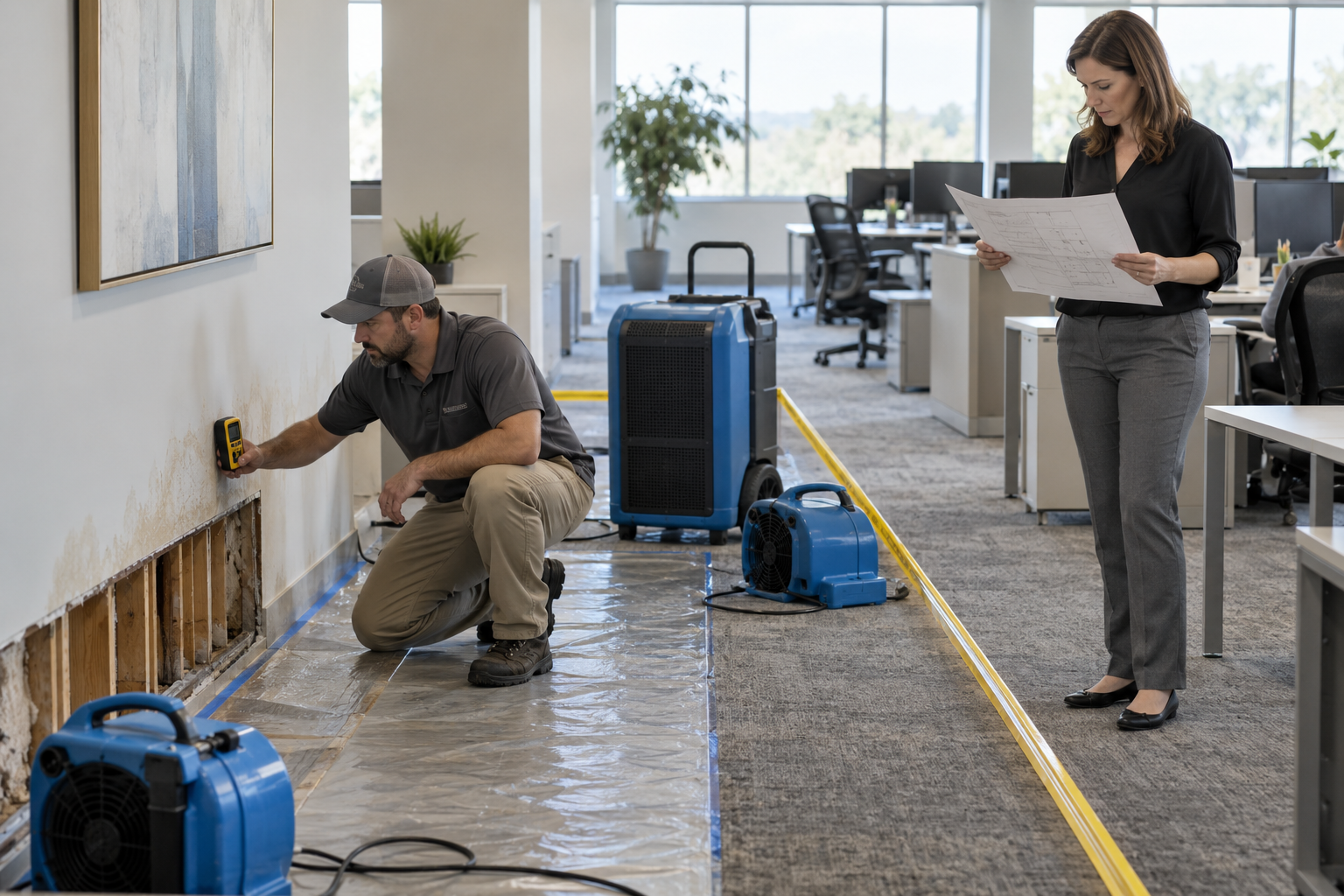
Step 1: Moisture Mapping
Thermal imaging cameras and calibrated moisture meters map the full extent of water migration — not just the visible puddle. Water travels through wall cavities, under flooring, and into ceiling assemblies. A 10-square-foot puddle may reflect moisture wicked three feet up the drywall and migrated under laminate to the far wall.
Step 2: Extraction
Industrial truck-mounted or portable extractors remove standing water at hundreds of gallons per hour — a rate no household equipment can match. Weighted extraction heads pull water from carpet backing and pad. Flood cuts (horizontal drywall cuts 12–18 inches above the water line) may be required to expose wet wall cavities for effective drying.
Step 3: Structural Drying
High-velocity air movers accelerate evaporation from wet surfaces. LGR (low-grain refrigerant) dehumidifiers capture the evaporated moisture before it can redeposit or raise ambient humidity to mold-supportive levels. Technicians take daily moisture readings logged against IICRC S500 target levels — the job is complete when materials reach equilibrium, not when an arbitrary timeline expires.
Standard drying for a basement water intrusion takes 3–5 days. Complex events involving multiple floors or structural saturation take longer.
Common Emergency Call Types in Calgary
| Event Type | Common Cause | Water Category | Typical Season |
|---|---|---|---|
| Burst pipe | Freeze-thaw stress on exterior walls, crawl spaces | Category 1 (clean) | Oct–Apr |
| Sump pump failure | Pump failure or power outage during melt | Category 1–2 | Mar–May |
| Appliance failure | Washing machine hose, dishwasher, water heater | Category 1–2 | Year-round |
| Ice dam intrusion | Meltwater backing under shingles at eaves | Category 1 | Jan–Mar |
| Sewage backup | Municipal surcharge, lateral blockage | Category 3 (biohazard) | Mar–May, heavy rain |
Sewage backup is a separate and more serious category requiring biohazard protocols. See our dedicated sewage backup cleanup service for the specific protocols involved.
Why Calgary Has More After-Hours Emergencies Than Most Cities
Calgary averages roughly 114 frost-free days per year — meaning freezing temperatures are possible for nearly 250 days. This drives a significantly higher incidence of freeze-related pipe failures than cities like Vancouver or Toronto.
Chinook warming events compound the risk. A chinook can raise temperatures 20°C in hours, rapidly melting snow on roofs and overwhelming gutters designed for gradual drainage. Older inner-city neighbourhoods — Hillhurst, Killarney, Capitol Hill, Inglewood — have galvanized steel or cast iron plumbing from the 1940s–60s that can fail suddenly. Newer suburbs like Evanston and Skyview Ranch have modern PEX but often feature complex finished basements that sustain disproportionate damage when water intrudes.
Saving the number for an emergency restoration service before an event occurs is one of the most practical steps a Calgary homeowner can take.
What to Ask Before You Commit
- Are your technicians IICRC-certified? IICRC S500 certification means training in moisture science, drying methodology, contamination categories, and documentation — and it matters to insurance adjusters.
- Will you work directly with my insurance company? Reputable companies submit moisture logs and drying validation reports in the format insurers expect.
- What is your specific response time? "As soon as we can" is not a commitment. Hold them to a concrete arrival window.
- Will you provide a written scope of work? The scope should detail materials to be removed, equipment to be placed, expected drying timeline, and monitoring schedule — in writing, before work begins.
Alberta Insurance and Documentation
Most Alberta homeowner policies cover sudden and accidental water damage from internal sources — burst pipes, appliance failures, fixture overflows. Gradual leaks, overland flooding, and sewer backup typically require separate endorsements. Review your policy before an emergency so you know what you're working with.
Key documentation for your claim:
- Photos and video of every affected area before cleanup begins
- Photos of any materials (carpet, drywall) before and during removal
- Receipts for all temporary repairs and out-of-pocket expenses
- IICRC-compliant drying log from your restoration company (daily moisture readings, equipment log, final clearance)
If your event involved sewage, the City of Calgary operates a backwater valve rebate program — contact 311 to inquire about applicable programs. For more on what qualifies for professional restoration, see our guide to water damage restoration in Calgary.
The Cost of Waiting
| Time Since Event | Typical Damage State | Estimated Cost Impact (CAD) |
|---|---|---|
| 0–2 hours | Surface-level: wet carpet, standing water, wet drywall surface | $2,000–$6,000 mitigation |
| 2–8 hours | Wicking into wall assemblies, engineered hardwood beginning to cup | $5,000–$12,000 |
| 8–24 hours | Structural material damage, drywall integrity loss, subfloor swelling | $10,000–$20,000+ |
| 24–72 hours | Mold colonization begins, job escalates from mitigation to remediation | $15,000–$50,000+ |
Insurers prefer to pay for drying over replacement. A well-documented early response often results in a faster, smoother claim settlement. The math strongly favours calling immediately. See our overview of 24/7 restoration services in Calgary for more on what professional response includes.
Frequently Asked Questions
How quickly can Calgary Restoration respond to a water emergency at night?
Calgary Restoration operates true 24/7 emergency response with live dispatch around the clock. When you call, a dispatcher answers immediately and mobilizes a crew — our target is within two hours of your call in Calgary. We do not route after-hours calls to voicemail.
Does my Alberta homeowner insurance cover a burst pipe at 2 a.m.?
Most standard Alberta homeowner policies cover sudden and accidental water damage from internal sources such as burst pipes and appliance failures, regardless of time of day. The key term is "sudden" — gradual or pre-existing leaks are often excluded. Document everything thoroughly before and during cleanup, as this forms the basis of your claim.
Should I try to dry the basement myself before calling a restoration company?
Household fans and dehumidifiers are not a substitute for professional drying. They lack the capacity to remove moisture from wall cavities, subfloor assemblies, and structural framing at the rate needed to prevent secondary damage. Running fans without moisture monitoring can also spread moisture to adjacent areas. Call for professional help first; running household fans while you wait is acceptable but not a replacement.
What equipment does a professional restoration crew bring?
A professional crew brings truck-mounted or portable extractors, thermal imaging cameras, calibrated moisture meters, industrial air movers, and LGR dehumidifiers. Larger events may require desiccant dehumidifiers and injection drying systems for sealed wall cavities. Equipment selection is based on the scope and contamination category of the event.
What is the difference between water damage mitigation and restoration?
Mitigation is the emergency response phase: extraction, drying, and structural stabilization. Restoration is the reconstruction phase: replacing drywall, flooring, insulation, and other removed materials. Calgary Restoration handles both under a single contract, eliminating the need to coordinate separate vendors and simplifying the insurance claims process. Learn more on our water damage restoration page.
Call Calgary Restoration Any Time — Day or Night
Water damage doesn't follow a schedule, and neither do we. When you call, you reach a live dispatcher who mobilizes a certified crew immediately. We bring the equipment, the IICRC-certified expertise, and the insurance documentation that Calgary homeowners need at the worst possible moment.
Don't wait until morning. Contact us now through our contact page or call our emergency line directly. We are in Calgary, we know Calgary homes, and we are ready to respond right now.
Easy steps to create a color palette
Lorem ipsum dolor sit amet, consectetur adipiscing elit lobortis arcu enim urna adipiscing praesent velit viverra sit semper lorem eu cursus vel hendrerit elementum morbi curabitur etiam nibh justo, lorem aliquet donec sed sit mi dignissim at ante massa mattis.
- Neque sodales ut etiam sit amet nisl purus non tellus orci ac auctor
- Adipiscing elit ut aliquam purus sit amet viverra suspendisse potent
- Mauris commodo quis imperdiet massa tincidunt nunc pulvinar
- Excepteur sint occaecat cupidatat non proident sunt in culpa qui officia
What is a color palette?
Vitae congue eu consequat ac felis placerat vestibulum lectus mauris ultrices cursus sit amet dictum sit amet justo donec enim diam porttitor lacus luctus accumsan tortor posuere praesent tristique magna sit amet purus gravida quis blandit turpis.

Don’t overspend on growth marketing without good retention rates
At risus viverra adipiscing at in tellus integer feugiat nisl pretium fusce id velit ut tortor sagittis orci a scelerisque purus semper eget at lectus urna duis convallis porta nibh venenatis cras sed felis eget neque laoreet suspendisse interdum consectetur libero id faucibus nisl donec pretium vulputate sapien nec sagittis aliquam nunc lobortis mattis aliquam faucibus purus in.
- Neque sodales ut etiam sit amet nisl purus non tellus orci ac auctor
- Adipiscing elit ut aliquam purus sit amet viverra suspendisse potenti
- Mauris commodo quis imperdiet massa tincidunt nunc pulvinar
- Adipiscing elit ut aliquam purus sit amet viverra suspendisse potenti
What’s the ideal customer retention rate?
Nisi quis eleifend quam adipiscing vitae aliquet bibendum enim facilisis gravida neque euismod in pellentesque massa placerat volutpat lacus laoreet non curabitur gravida odio aenean sed adipiscing diam donec adipiscing tristique risus amet est placerat in egestas erat.
“Lorem ipsum dolor sit amet consectetur adipiscing elit, sed do eiusmod tempor incididunt ut labore et dolore magna aliqua enim ad minim veniam.”
Next steps to increase your customer retention
Eget lorem dolor sed viverra ipsum nunc aliquet bibendum felis donec et odio pellentesque diam volutpat commodo sed egestas aliquam sem fringilla ut morbi tincidunt augue interdum velit euismod eu tincidunt tortor aliquam nulla facilisi aenean sed adipiscing diam donec adipiscing ut lectus arcu bibendum at varius vel pharetra nibh venenatis cras sed felis eget.