Water Restoration: The Complete Process Explained
The water restoration process follows seven distinct steps: emergency response, water extraction, moisture assessment, structural drying, controlled demolition if needed, mold prevention or remediation, and reconstruction. The entire process typically takes 7–21 days, with the drying phase alone requiring a minimum of 3–5 days regardless of how fast crews work.
Quick Answer:Water restoration follows the IICRC S500 standard and begins with emergency extraction (Day 1), progresses through industrial structural drying (Days 1–5), moisture verification (Day 3–5), controlled demolition of unsalvageable materials, mold prevention or remediation if needed, and full reconstruction. In Calgary, costs range from $2,000 to $15,000+ CAD depending on damage severity and water category.
Step 1: Emergency Response (Hour 0–2)
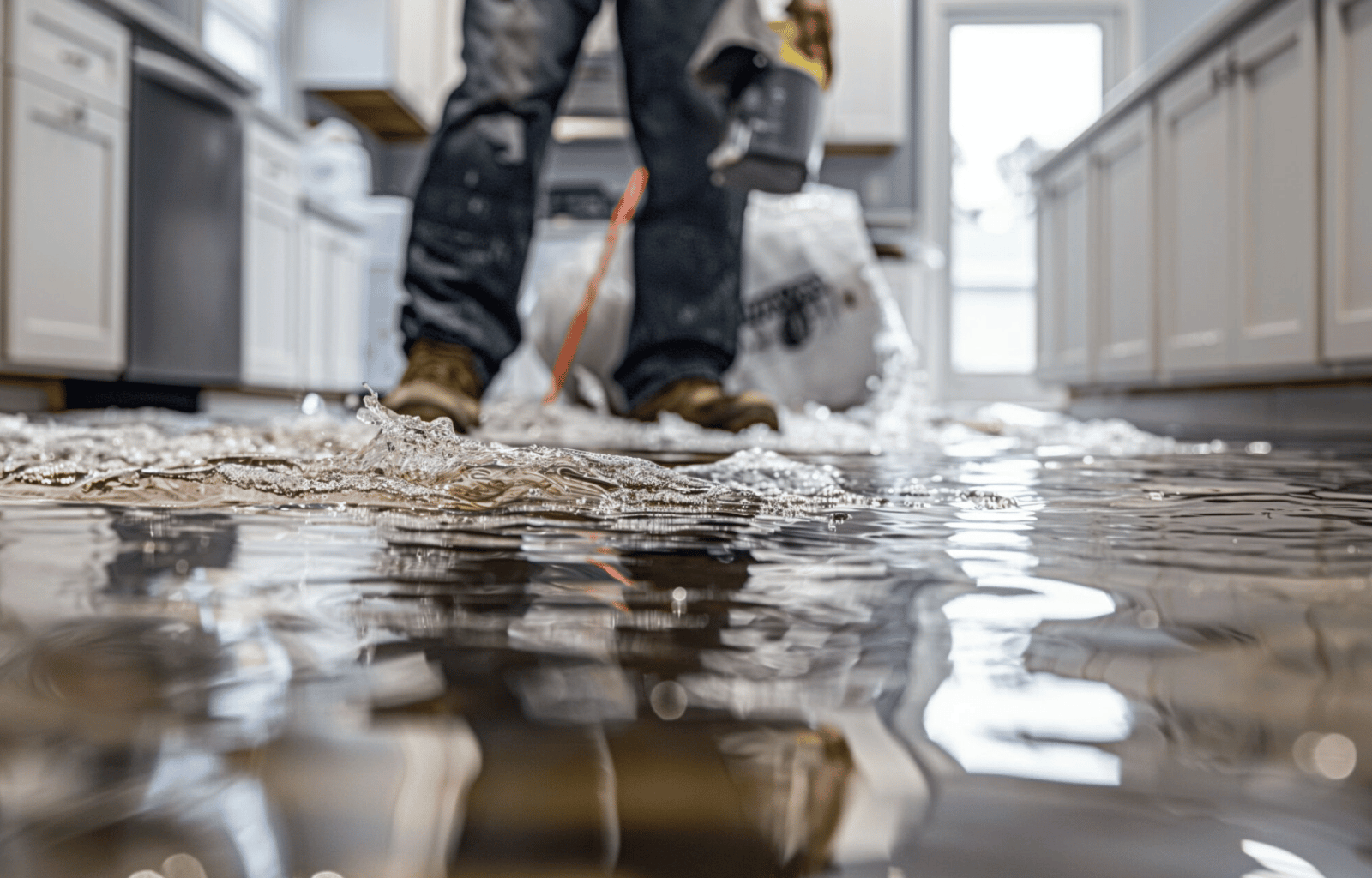
The process begins the moment you call. Certified technicians dispatch within minutes and typically arrive at a Calgary address within 1–2 hours of an emergency call. Time matters: every additional hour that water sits in contact with structural materials increases saturation depth and mold risk.
On arrival, the first tasks are:
- Confirm the water source is stopped (main shutoff, appliance valve, or sump pump failure identified)
- Assess safety — power to affected areas, potential hazardous materials, sewage contamination
- Classify the water: Category 1 (clean), Category 2 (grey), or Category 3 (black/contaminated)
- Photograph all affected areas for insurance documentation before any work begins
- Classify the damage level: Class 1 (limited absorption) through Class 4 (deeply absorbed in dense materials)
Step 2: Water Extraction (Hour 2–6)
Bulk water removal is the immediate priority after safety is confirmed. Industrial extraction removes far more water per hour than any consumer equipment, which directly reduces the volume of moisture the structural materials must absorb and re-evaporate during drying.
- Truck-mounted extractors — The most powerful units, capable of removing hundreds of gallons per hour
- Portable extraction units — Used in areas trucks can't access (upper floors, confined spaces)
- Weighted extraction wands — Applied directly to carpets to remove water embedded in pile and pad
- Floor squeegees and wands — For hard surface and concrete floors
Saturated carpet pad is almost never salvageable and is removed at this stage. Carpet may be salvageable if the water was Category 1 and extraction was rapid; Category 2 or 3 water contact means carpet disposal is required.
Step 3: Moisture Assessment and Mapping (Hour 3–8)
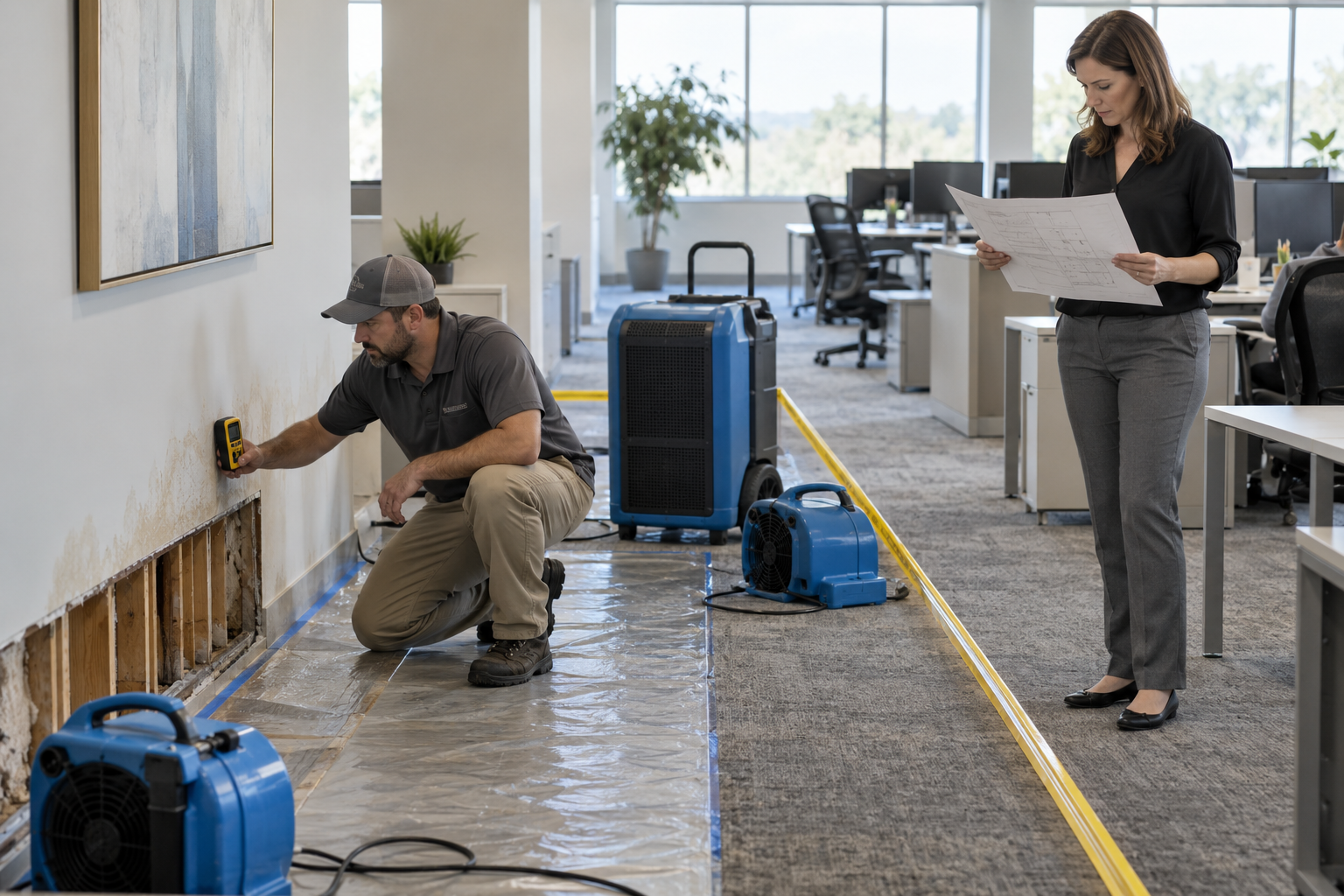
After bulk extraction, technicians conduct a thorough moisture assessment to map the full extent of saturation. This step determines drying strategy, equipment placement, and what materials may need to be removed.
- Pin-type moisture meters — Penetrating probes measure moisture content in wood framing and subfloor (target: below 19% for wood)
- Pinless moisture meters — Scan moisture behind surfaces without penetration (useful for finished walls)
- Thermal imaging cameras — Detect temperature differentials caused by evaporating moisture, revealing hidden wet areas behind drywall
- Psychrometric readings — Temperature, relative humidity, dew point, and specific humidity tracked to model drying conditions
The moisture map documents which materials are affected, at what levels, and where water has migrated. This baseline is essential for tracking drying progress and for insurance documentation.
Quick Answer:Hidden moisture is the most common cause of restoration failures. Water migrates laterally through walls and vertically through floors and ceilings far beyond where it's visible. Thermal imaging and calibrated meters are required to find all affected areas — visual inspection alone is insufficient and often misses moisture that will later cause mold.
Step 4: Structural Drying and Dehumidification (Days 1–5)
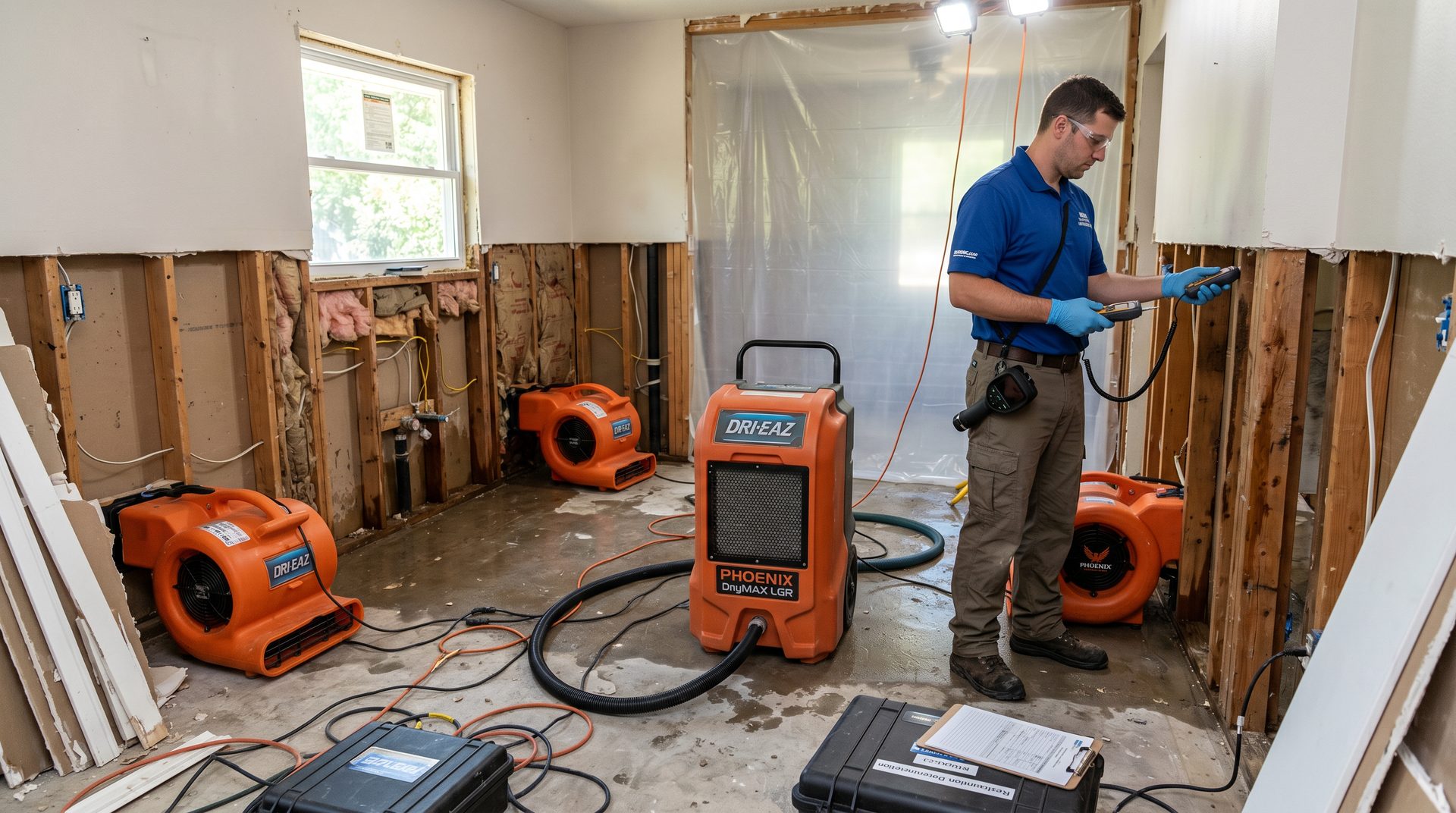
Structural drying is the longest and most equipment-intensive phase of water restoration. Water that has penetrated drywall, insulation, wood framing, and concrete cannot be removed mechanically — it must be evaporated from within the material and captured by dehumidification equipment.
The Drying System: How It Works
- Air movers (high-velocity fans) create rapid airflow across wet surfaces, accelerating evaporation from drywall, flooring, and framing
- Commercial dehumidifiers capture the moisture-laden air and condense it out, keeping the room's humidity low so evaporation can continue
- As moisture evaporates from surface materials, moisture migrates from deeper layers toward the surface — which is why readings must be taken daily and equipment repositioned
- The cycle continues until all materials reach target moisture content as specified in IICRC S500
Equipment Placement Strategy
- Air movers positioned at a 45-degree angle toward walls to maximize wall and floor drying simultaneously
- One air mover per 50–70 square feet of affected area is a general guideline
- Dehumidifiers sized to the volume of the space and the measured moisture load
- Equipment cannot be turned off overnight — continuous operation is required for effective drying
Specialty Drying for Calgary Conditions
- Desiccant dehumidifiers — More effective than refrigerant units in Calgary's cold winter temperatures (below 15°C)
- Injectidry systems — Inject dry air directly into wall cavities and under subfloors via small holes, enabling drying without full demolition
- Hardwood floor drying systems — Specialized mats with vacuum assist to dry hardwood in place without cupping or buckling (when caught early enough)
Step 5: Daily Monitoring and Documentation (Days 2–5)
A technician returns every day during the drying cycle to take readings and update the drying log. This is a core professional obligation, not a courtesy visit — without daily monitoring, you cannot confirm the drying is working or when it is complete.
Each daily monitoring visit includes:
- Moisture readings at all previously mapped points
- Psychrometric readings (temperature and humidity)
- Assessment of whether equipment needs to be repositioned or supplemented
- Notes on any changes in affected materials (swelling, staining, odor)
- Entry in the written drying log
The drying log is the insurance company's primary verification that the job was done correctly. Request a copy for your records at the end of the job.
Step 6: Controlled Demolition (Days 1–4, as needed)
Some materials cannot be dried in place and must be removed before drying can be completed or before reconstruction can begin. This is called "controlled demolition" or "tear-out."
Common Materials Removed After Water Damage
- Drywall — Typically cut at or above the saturation line (the "flood cut"). A standard 4-foot flood cut removes the bottom section of walls. Full removal is required if the entire wall cavity is saturated or if Category 3 water was involved.
- Insulation — Batt insulation absorbs water and cannot be dried effectively; it is always removed and replaced
- Subfloor panels — OSB subfloor swells and delaminates when saturated; affected panels are cut out and replaced
- Carpet and pad — Pad is almost never salvageable; carpet from Category 2/3 events is disposed of
- Baseboards and trim — Wood trim absorbs moisture and may need removal to allow wall drying
Demolition scope is determined by moisture readings and the category of water involved — it should never be done preemptively or more aggressively than required by moisture data.
Step 7: Mold Prevention and Remediation (Days 1–10, if needed)
Mold prevention begins on Day 1 with rapid drying and antimicrobial application. If the drying response is fast enough (within 24–48 hours), mold growth in Calgary homes can typically be prevented. When water sat longer, or when the home had pre-existing moisture problems, active mold growth requires a full remediation response.
Mold Prevention (Standard on All Jobs)
- EPA-registered antimicrobial agents applied to all exposed structural surfaces after extraction
- Rapid reduction of humidity through dehumidification
- Removal of wet organic materials (insulation, drywall) that would otherwise support growth
Mold Remediation (When Growth is Present)
When active mold is identified, the project follows IICRC S520 protocols:
- Containment with plastic sheeting and negative air pressure
- HEPA-filtered air scrubbers running continuously
- Physical removal of all mold-contaminated materials
- HEPA vacuuming of remaining structural surfaces
- Antimicrobial treatment of all exposed framing and concrete
- Post-remediation clearance testing by an independent party
Learn more about our mold remediation protocols and when full remediation is required.
Step 8: Final Moisture Clearance (Day 3–7)
The drying phase is only complete when all structural materials have reached their target moisture content levels per IICRC S500. These targets vary by material:
| Material | Target Moisture Content |
|---|---|
| Wood framing and subfloor | Below 19% (ideally 12–15%) |
| Drywall (gypsum) | Below 1% moisture content |
| Concrete | Matching dry, unaffected reference reading |
| Hardwood flooring | Within 4% of species equilibrium moisture content |
Once all materials hit target levels, equipment is removed and the final drying documentation is compiled. This documentation package — moisture map, daily logs, final readings, scope of work — goes to your insurer as the completion record.
Step 9: Reconstruction (Days 5–21)
Reconstruction begins only after moisture clearance is confirmed. Starting reconstruction over wet framing or drywall traps moisture inside finished walls, guaranteeing future mold problems.
Reconstruction scope mirrors the demolition scope:
- New drywall installed, taped, mudded, and sanded
- New insulation (batt or spray foam) installed per Alberta building code
- Subfloor panels replaced and leveled
- New flooring installed — carpet, hardwood, laminate, or tile
- Baseboards, trim, and millwork reinstalled
- Paint and finish work throughout affected areas
Complete Process Timeline
| Phase | Timeline | Key Activities |
|---|---|---|
| Emergency response and extraction | Hours 1–6 | Dispatch, arrival, bulk water removal |
| Moisture assessment | Hours 3–8 | Meter readings, thermal imaging, moisture map |
| Equipment setup | Hours 4–12 | Air movers, dehumidifiers deployed |
| Structural drying | Days 1–5 | Continuous drying, daily monitoring |
| Controlled demolition | Days 1–4 (as needed) | Flood cut drywall, insulation, subfloor removal |
| Mold prevention/remediation | Days 1–10 (if needed) | Antimicrobials, containment, physical removal |
| Moisture clearance | Days 3–7 | Final readings, documentation, equipment removal |
| Reconstruction | Days 5–21 | Drywall, insulation, flooring, paint, trim |
Water Restoration Process by Water Category
| Category | Source Example | Key Protocol Differences |
|---|---|---|
| Category 1 (Clean) | Burst supply pipe, appliance overflow | Standard drying; carpet may be salvageable; no antimicrobial required on structural surfaces unless delayed |
| Category 2 (Grey) | Dishwasher, washing machine, toilet overflow (urine only) | Antimicrobial treatment required; carpet pad disposal required; porous material contact assessed for disposal |
| Category 3 (Black) | Sewage backup, groundwater flooding, river flood | Full PPE, all porous contact materials disposed, biohazard decontamination, sewage backup cleanup protocol |
Frequently Asked Questions
How long does the water restoration process take?
The drying phase takes a minimum of 3–5 days with professional industrial equipment. Full restoration from emergency call through completed reconstruction takes 7–21 days for most Calgary incidents. Severe flooding with mold involvement can extend to 30 days or more.
Can the drying process be speeded up?
Industrial equipment dries 2–3 times faster than consumer equipment, but there is a physical limit to how fast moisture can move through structural materials. Typical drying goals cannot be achieved in under 3 days without risking incomplete drying. Adding more equipment beyond optimal levels does not speed things up meaningfully.
What happens if drying is not completed properly?
Residual moisture in walls, subfloor, and framing leads to mold growth — often within days in Calgary's typical basement temperatures. Mold discovered months after "completed" restoration work is a sign of incomplete drying. Remediation of subsequent mold is generally not covered by insurance and falls to the homeowner.
Do I need to leave my home during water restoration?
For most Category 1 water damage jobs, you can remain in your home during the drying phase. Category 3 contamination (sewage, flood water) typically requires temporary relocation during active remediation. Your restoration company will advise based on the scope of work and containment requirements.
What documents should I receive after water restoration?
You should receive: initial moisture map, daily drying logs with readings, final moisture clearance readings, scope of work document, and a completion certificate. These documents support your insurance claim and provide proof that restoration was completed per IICRC S500 standards.
How do I know the drying is actually finished?
Drying is complete when calibrated moisture meters confirm all affected materials have reached target moisture content levels per IICRC S500. "Feels dry" or "looks dry" are not sufficient — concrete and wood framing can hold moisture long after the surface appears dry. Insist on documented meter readings before equipment is removed.
What is the IICRC S500 standard in water restoration?
The IICRC S500 is the professional standard that governs water damage restoration. It defines assessment procedures, equipment requirements, drying protocols, target moisture levels for each material type, and documentation standards. Any certified restoration company in Calgary should be able to confirm their work follows S500. See our full overview of water damage restoration and our emergency restoration services.
Easy steps to create a color palette
Lorem ipsum dolor sit amet, consectetur adipiscing elit lobortis arcu enim urna adipiscing praesent velit viverra sit semper lorem eu cursus vel hendrerit elementum morbi curabitur etiam nibh justo, lorem aliquet donec sed sit mi dignissim at ante massa mattis.
- Neque sodales ut etiam sit amet nisl purus non tellus orci ac auctor
- Adipiscing elit ut aliquam purus sit amet viverra suspendisse potent
- Mauris commodo quis imperdiet massa tincidunt nunc pulvinar
- Excepteur sint occaecat cupidatat non proident sunt in culpa qui officia
What is a color palette?
Vitae congue eu consequat ac felis placerat vestibulum lectus mauris ultrices cursus sit amet dictum sit amet justo donec enim diam porttitor lacus luctus accumsan tortor posuere praesent tristique magna sit amet purus gravida quis blandit turpis.

Don’t overspend on growth marketing without good retention rates
At risus viverra adipiscing at in tellus integer feugiat nisl pretium fusce id velit ut tortor sagittis orci a scelerisque purus semper eget at lectus urna duis convallis porta nibh venenatis cras sed felis eget neque laoreet suspendisse interdum consectetur libero id faucibus nisl donec pretium vulputate sapien nec sagittis aliquam nunc lobortis mattis aliquam faucibus purus in.
- Neque sodales ut etiam sit amet nisl purus non tellus orci ac auctor
- Adipiscing elit ut aliquam purus sit amet viverra suspendisse potenti
- Mauris commodo quis imperdiet massa tincidunt nunc pulvinar
- Adipiscing elit ut aliquam purus sit amet viverra suspendisse potenti
What’s the ideal customer retention rate?
Nisi quis eleifend quam adipiscing vitae aliquet bibendum enim facilisis gravida neque euismod in pellentesque massa placerat volutpat lacus laoreet non curabitur gravida odio aenean sed adipiscing diam donec adipiscing tristique risus amet est placerat in egestas erat.
“Lorem ipsum dolor sit amet consectetur adipiscing elit, sed do eiusmod tempor incididunt ut labore et dolore magna aliqua enim ad minim veniam.”
Next steps to increase your customer retention
Eget lorem dolor sed viverra ipsum nunc aliquet bibendum felis donec et odio pellentesque diam volutpat commodo sed egestas aliquam sem fringilla ut morbi tincidunt augue interdum velit euismod eu tincidunt tortor aliquam nulla facilisi aenean sed adipiscing diam donec adipiscing ut lectus arcu bibendum at varius vel pharetra nibh venenatis cras sed felis eget.