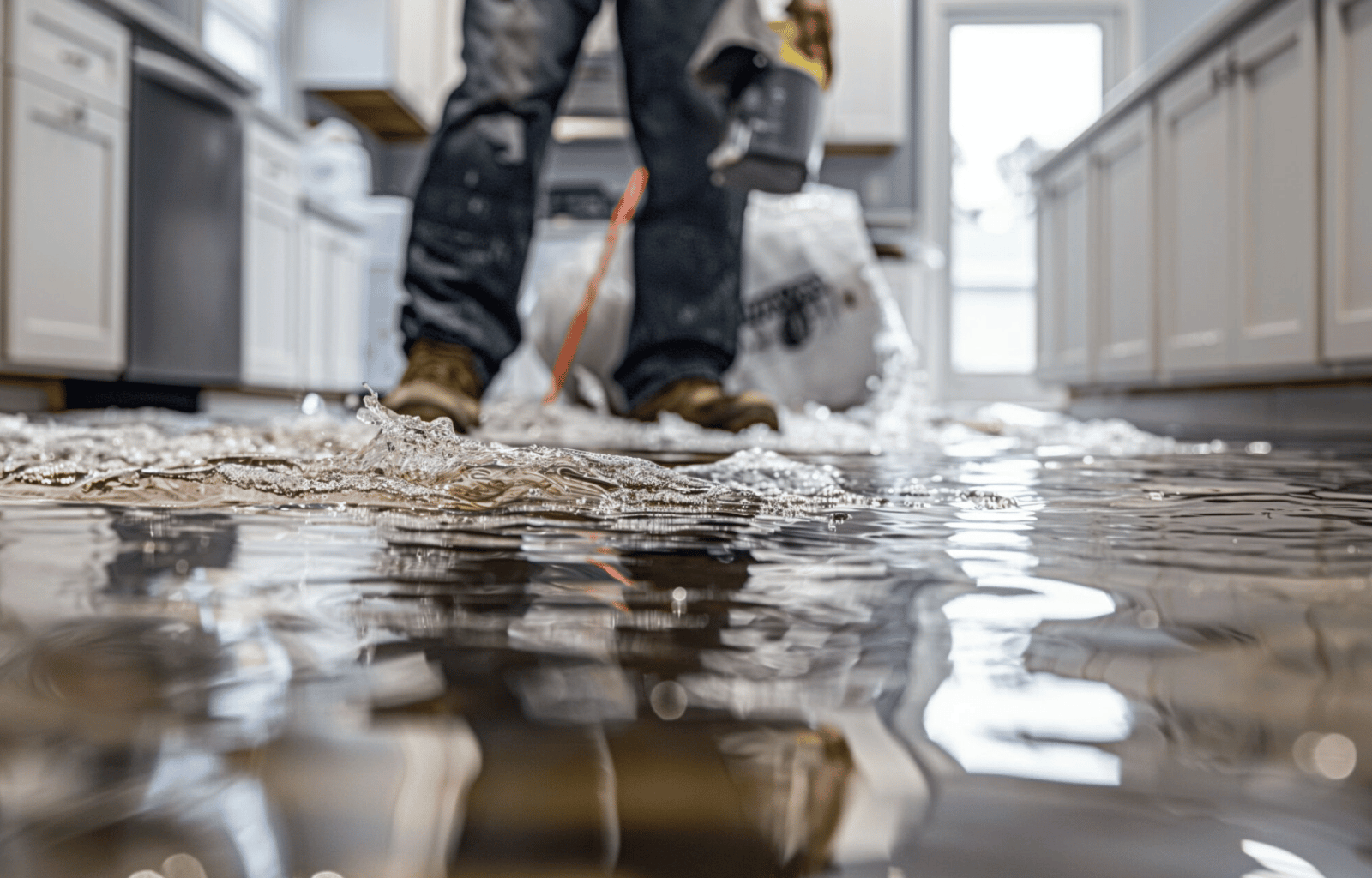
Quick Answer:Subfloor repair after water damage depends on the extent of saturation and structural degradation. OSB subfloor wet for less than 48 hours with moderate moisture elevation can often be dried in place; OSB wet for more than 72 hours, or showing delamination, swelling, or softness, requires replacement. Professional moisture assessment using pin meters and thermal imaging is required to make this determination accurately.
How Water Damages Subflooring: The Material Science
Residential subfloor in Calgary homes built after the late 1980s is almost universally OSB (oriented strand board) — an engineered panel manufactured from compressed wood strands bonded with adhesive resin. OSB is dimensionally stable under normal conditions, but when it absorbs water, the wood strands swell, the adhesive bonds weaken, and the surface begins to delaminate. The characteristic strand-pattern telegraphing through finished flooring is an early indicator of partially wet-and-dried OSB.
Plywood subfloor — more common in older Calgary homes and higher-quality construction — behaves somewhat better under water exposure but is not immune. Water absorbs readily through cut edges, and prolonged saturation causes delamination between plies. Plywood wet-and-dried multiple times shows progressive degradation with each cycle.
Solid-wood plank subfloor, found in Calgary homes built before the 1960s in areas like Inglewood, Ramsay, and Highland Park, responds differently. Solid wood swells across the grain, and adjacent planks develop cupping and crowning that is only partially reversible. The advantage: solid wood can often be dried, planed, and repaired rather than fully replaced, provided underlying framing is intact and the wood hasn't been chronically wet.
Professional Subfloor Assessment: What It Includes
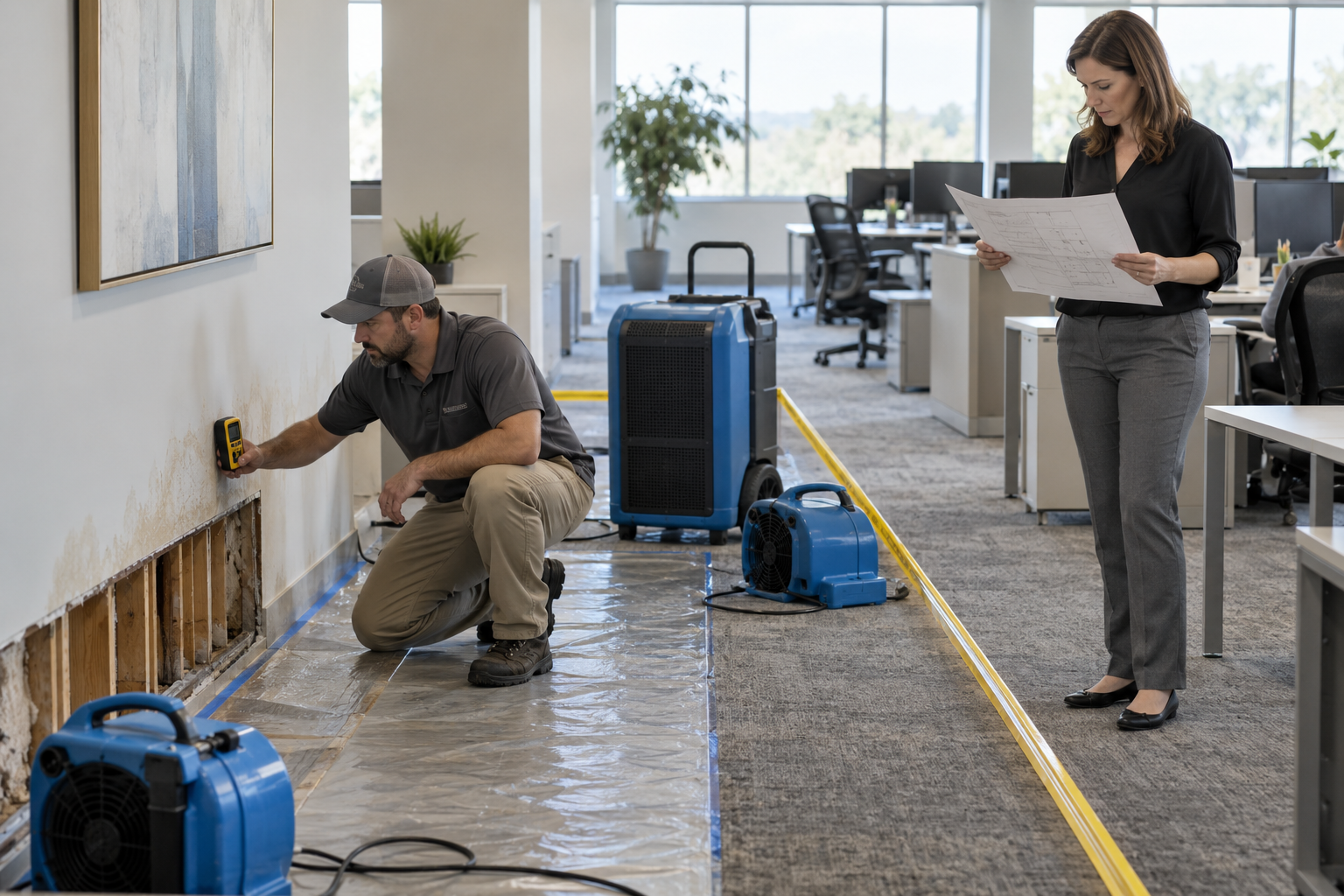
A proper assessment requires more than walking across the floor looking for soft spots. Professional assessment begins with pin moisture meters measuring actual moisture content at multiple points across the affected area. The IICRC S500 target for wood subfloor is below 16% — above this level, conditions supporting mold growth and continued dimensional change are present.
Assessment Tools and What They Find
- Pin moisture meters — Measure actual moisture content at specific penetration points; quantify saturation and track drying progress
- Pinless (radio frequency) meters — Read subsurface moisture without penetrating the material; used for wide-area scanning
- Thermal imaging cameras — Identify wet zones beneath tile, hardwood, or intact finish flooring without requiring floor removal for exploratory investigation
- Deflection testing — Physical pressure applied to subfloor surface; intact OSB shows no perceptible movement; compromised OSB deflects noticeably
- Visual inspection of edges and fastener areas — Swelling at panel edges, crumbling at fastener points, and surface delamination indicate material failure
Thermal imaging is particularly valuable in Calgary homes where subfloor is covered by ceramic tile set in mortar — a material that masks wet subfloor underfoot and prevents evaporative drying from the surface. Thermal imaging identifies wet zones beneath tile without requiring tile removal, allowing an accurate scope to be established before demolition begins.
Repair vs. Replacement: Making the Right Call
| Condition | Recommendation |
|---|---|
| Wet less than 24–48 hrs; moisture 16–25%; no delamination or softness | Dry in place with commercial drying equipment; verify post-drying |
| Wet 48–72 hrs; moisture 20–30%; minor surface telegraphing | Assess for structural integrity; may dry in place if no delamination |
| Wet more than 72 hrs; moisture above 25–30%; visible swelling, delamination, or edge crumbling | Replace — structural performance cannot be restored |
| Soft underfoot; deflection when walked on; adhesive failure at fasteners | Replace — cannot safely support finish flooring or normal foot traffic |
| Mold growth visible on subfloor surface or confirmed on underside | Replace per IICRC S520 mold remediation protocol |
Attempting to dry and reuse heavily damaged OSB is false economy. Degraded OSB does not return to its original structural performance after significant saturation, and finish flooring installed over compromised subfloor will fail prematurely — showing squeaks, bounce, and surface irregularity within months.
The Subfloor Repair and Replacement Process
- Finish floor removal — Carpet, laminate, vinyl, or hardwood is removed to expose the subfloor. Ceramic tile requires more invasive removal and may increase project scope.
- Subfloor moisture assessment — Pin meter readings at a grid of points across the entire affected area; thermal imaging to identify areas of retained moisture under intact finish materials.
- Underlayment removal — Saturated underlayment (foam, felt, or cork) is removed in all cases — it cannot be effectively dried and provides a growth substrate.
- Subfloor evaluation — Deflection testing, visual inspection of edges and fastener areas, and moisture readings determine repair vs. replacement scope.
- Joist assessment — Floor framing below the subfloor is assessed for moisture content, structural integrity, and any signs of decay or compromised engineered wood web sections.
- Damaged panel removal (if replacement required) — Panels are cut and removed, exposing joists for assessment and treatment.
- Commercial drying — Whether repair or replacement, the joist cavity and remaining structural members are dried to IICRC S500 targets before any new panels are installed. Drying mats placed against the underside of intact subfloor panels accelerate moisture removal in place.
- Mold treatment — Exposed framing and any subfloor panels retained in place are treated with EPA-registered antimicrobial solution after drying targets are achieved.
- New subfloor installation (if replacement required) — New OSB or plywood panels installed per Alberta building code, with appropriate fastener patterns and expansion gaps.
- Post-drying moisture verification — Readings taken at multiple points on consecutive days confirm target moisture levels before any finish flooring is installed.
Subfloor Repair Cost Ranges in Calgary
| Scope | Typical Cost (CAD) | Notes |
|---|---|---|
| Dry-in-place (commercial drying equipment, no replacement) | $1,500 – $3,500 | Depends on affected area and drying duration |
| Partial replacement (1–2 panels, localized damage) | $2,000 – $5,000 | Plus finish floor replacement cost |
| Full room subfloor replacement | $4,000 – $10,000 | Plus finish floor and any joist repairs |
| Multi-room or whole basement subfloor replacement | $8,000 – $20,000+ | Including joist assessment and finish floor |
Subfloor repair costs are covered under the dwelling portion of most Alberta homeowner's insurance policies when the damage results from a covered water loss event. Proper documentation — moisture readings, assessment reports, and photographs taken before demolition — is essential for a successful claim.
Calgary-Specific Subfloor Risks
- Spring snowmelt flooding (March–May) — The highest-volume water damage season in Calgary. Basement subfloor is the first structural component to absorb floodwater.
- Freeze-thaw pipe bursts (January–February) — Supply lines in exterior walls or unheated spaces can fail overnight, exposing subfloor to hours of water contact before discovery.
- Sewer backup — Category 3 contaminated water requires complete removal of any subfloor in direct contact per IICRC S520 biohazard protocols. See our sewage backup cleanup guide.
- Radiant floor heating — Homes with in-floor radiant systems have a significantly more complex drying and repair process; the heating system must be evaluated by a mechanical contractor in addition to the restoration scope.
Frequently Asked Questions
How do I know if my subfloor is damaged after a basement flood?
Early signs include: bounce or give when walked on, squeaking that wasn't present before, visible swelling at panel seams, surface telegraphing of the OSB strand pattern through finish flooring, and buckling or separation of laminate or hardwood flooring above. Musty odour in the basement can indicate mold beginning in a saturated subfloor even before visual signs are apparent. Professional moisture metering is required for accurate assessment — walking the floor and visual inspection alone will miss retained moisture in the subfloor interior and at the panel edges.
Can I install new flooring over water-damaged subfloor?
No — installing finish flooring over subfloor that has not been dried to IICRC S500 moisture targets (below 16% for wood) will result in premature failure of the finish floor, continued mold risk in the subfloor assembly, and voided manufacturer warranties on any engineered flooring product. Any flooring contractor who installs product over a subfloor showing elevated moisture readings is exposing themselves to a warranty claim. Professional moisture verification with documented readings is required before any finish floor installation proceeds.
Will insurance pay for subfloor replacement after water damage in Alberta?
Yes — Alberta homeowner's insurance treats subfloor as a structural building component included under dwelling coverage. When damage results from a covered peril (burst pipe, appliance failure, covered sewer event), repair or replacement is included in the claim. The adjuster evaluates the scope based on the restoration company's written documentation of moisture content readings and structural assessment findings. Detailed documentation — readings before demolition, photographs, written assessment — is the evidence base for the subfloor scope in the insurance settlement.
How long does it take to dry a subfloor with professional equipment?
Commercial drying equipment typically achieves IICRC S500 moisture targets (below 16%) for wood subfloor in 3–7 days under standard Calgary basement conditions in summer. In winter, with lower ambient temperatures, the same drying may take 5–10 days. Drying is not declared complete until consistent readings at multiple points on consecutive days confirm targets are achieved throughout the affected area — not just at the surface of one panel. Daily moisture logs document progress and provide the evidence your insurance adjuster needs.
What happens to floor joists when the subfloor is water-damaged?
Solid lumber joists briefly wet and dried to normal moisture content typically retain structural performance. Joists wet for extended periods may develop wood decay fungi, requiring sistering (adding new lumber alongside the damaged joist) or replacement. Engineered I-joists with a saturated OSB web require assessment against manufacturer specifications and may need replacement even if they appear visually intact — the OSB web is as vulnerable to saturation damage as subfloor OSB. A professional assessment includes moisture readings in all joist framing and a structural evaluation of any areas showing deflection or visible deterioration.
Is subfloor mold dangerous?
Mold colonizing a subfloor in an enclosed basement space — particularly under carpet or vinyl where it cannot be seen — poses an air quality risk through spore off-gassing into the living environment above. Basements with subfloor mold frequently show elevated indoor spore concentrations. Per IICRC S520, subfloor with active mold growth must be removed rather than treated in place. If mold remediation is required alongside subfloor repair, the mold scope should be completed by an IICRC S520-certified company before reconstruction begins.
Don't guess about the condition of your subfloor after a flooding event. Contact our team for a professional moisture assessment before any flooring work begins — we document every step to support your insurance claim.
Easy steps to create a color palette
Lorem ipsum dolor sit amet, consectetur adipiscing elit lobortis arcu enim urna adipiscing praesent velit viverra sit semper lorem eu cursus vel hendrerit elementum morbi curabitur etiam nibh justo, lorem aliquet donec sed sit mi dignissim at ante massa mattis.
- Neque sodales ut etiam sit amet nisl purus non tellus orci ac auctor
- Adipiscing elit ut aliquam purus sit amet viverra suspendisse potent
- Mauris commodo quis imperdiet massa tincidunt nunc pulvinar
- Excepteur sint occaecat cupidatat non proident sunt in culpa qui officia
What is a color palette?
Vitae congue eu consequat ac felis placerat vestibulum lectus mauris ultrices cursus sit amet dictum sit amet justo donec enim diam porttitor lacus luctus accumsan tortor posuere praesent tristique magna sit amet purus gravida quis blandit turpis.

Don’t overspend on growth marketing without good retention rates
At risus viverra adipiscing at in tellus integer feugiat nisl pretium fusce id velit ut tortor sagittis orci a scelerisque purus semper eget at lectus urna duis convallis porta nibh venenatis cras sed felis eget neque laoreet suspendisse interdum consectetur libero id faucibus nisl donec pretium vulputate sapien nec sagittis aliquam nunc lobortis mattis aliquam faucibus purus in.
- Neque sodales ut etiam sit amet nisl purus non tellus orci ac auctor
- Adipiscing elit ut aliquam purus sit amet viverra suspendisse potenti
- Mauris commodo quis imperdiet massa tincidunt nunc pulvinar
- Adipiscing elit ut aliquam purus sit amet viverra suspendisse potenti
What’s the ideal customer retention rate?
Nisi quis eleifend quam adipiscing vitae aliquet bibendum enim facilisis gravida neque euismod in pellentesque massa placerat volutpat lacus laoreet non curabitur gravida odio aenean sed adipiscing diam donec adipiscing tristique risus amet est placerat in egestas erat.
“Lorem ipsum dolor sit amet consectetur adipiscing elit, sed do eiusmod tempor incididunt ut labore et dolore magna aliqua enim ad minim veniam.”
Next steps to increase your customer retention
Eget lorem dolor sed viverra ipsum nunc aliquet bibendum felis donec et odio pellentesque diam volutpat commodo sed egestas aliquam sem fringilla ut morbi tincidunt augue interdum velit euismod eu tincidunt tortor aliquam nulla facilisi aenean sed adipiscing diam donec adipiscing ut lectus arcu bibendum at varius vel pharetra nibh venenatis cras sed felis eget.