Quick Answer:When you call a 24/7 restoration service, expect a live dispatcher, a crew arrival within 1–2 hours, immediate safety assessment and moisture mapping, professional water extraction, controlled demolition for drying access, commercial drying equipment deployment, and complete documentation for your insurance claim. The responding technicians should hold IICRC certification appropriate to the loss type.
What "24/7 Restoration Services" Means in Practice
"24/7 restoration services" is used freely in the industry, and its actual meaning varies enormously. At the basic level, it means someone will answer the phone after hours. At the professional level, it means a fully equipped crew of certified technicians arrives within 1–2 hours of your call, any hour of the day or night, 365 days a year.
A genuine 24/7 emergency restoration operation maintains: a staffed dispatch line (not voicemail), on-call IICRC-certified technicians with credentials appropriate to the loss type (water, mold, sewage), vehicles loaded with extraction and drying equipment ready to deploy immediately, and a defined response window. The technicians who respond at 2 AM should be the same certified professionals who handle daytime projects — not general labourers filling an on-call shift.
Before you face an emergency, save the number of a verified 24/7 restoration company. In a crisis, you don't want to be researching options while water is spreading across your floor. Knowing in advance what company you'll call — and verifying their true after-hours capability — is the most important preparation a Calgary homeowner can make. Our overview of 24/7 restoration services in Calgary describes what genuine emergency response looks like locally.
The First Call: What Information to Provide
When you call during an emergency, the dispatcher needs specific information to deploy the right team and equipment. Provide this clearly and quickly:
- Type of loss — Water damage, sewage backup, fire, or mold
- Source of water — Burst pipe, appliance failure, sewer backup, storm intrusion, or unknown
- Whether water is still flowing — Has the source been stopped or is it still active?
- Area affected — Rooms and rough square footage, or number of floors involved
- Electrical safety concerns — Is there any possibility of electrical contact in the flooded area?
- Your address and best access point
The type of water matters significantly for crew preparation. A burst supply line is Category 1 (clean water) — standard extraction and drying equipment, no biohazard protocols. A sewer backup is Category 3 (black water) — full PPE including respirators, Tyvek suits, and gloves, plus specialized waste handling and decontamination. The dispatcher should ask about water source immediately and adjust the deployment accordingly. For sewage-specific guidance, see our sewage backup cleanup resource.
What to Do While Waiting for the Crew
Follow the dispatcher's immediate guidance. Standard advice for most water damage scenarios:
- Shut off water at the nearest valve if it is safe to do so
- Turn off electrical circuits serving the flooded area from a dry location — never enter water that may be in contact with live electrical
- For sewage backup: vacate the affected area entirely and keep all household members away from contaminated water
- Do not run fans across wet carpeting or standing water
- Do not use a household vacuum on standing water
- Document the scene with photos and video before moving anything — this pre-intervention record matters for your insurance claim
What Happens When the Restoration Crew Arrives
Phase 1: Safety Assessment
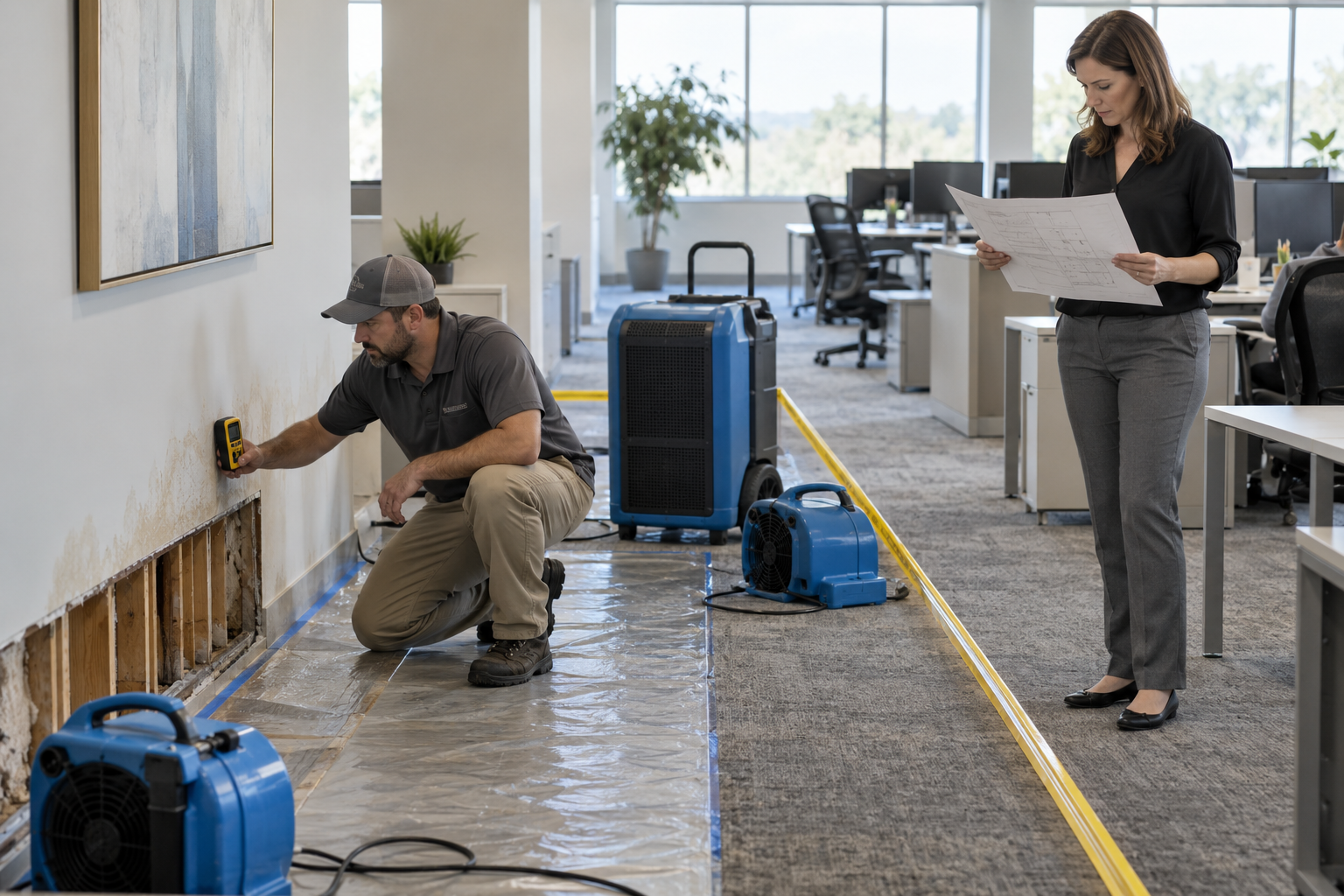
Before any equipment is deployed, the lead technician evaluates electrical safety (all circuits serving wet areas should be confirmed off), structural safety (unstable floors, water-loaded ceilings, hazardous stairways), and for Category 2 or 3 events, establishes the PPE protocol and documents the hazard status for the project record. No work begins until the area is confirmed safe to enter.
Phase 2: Moisture Mapping
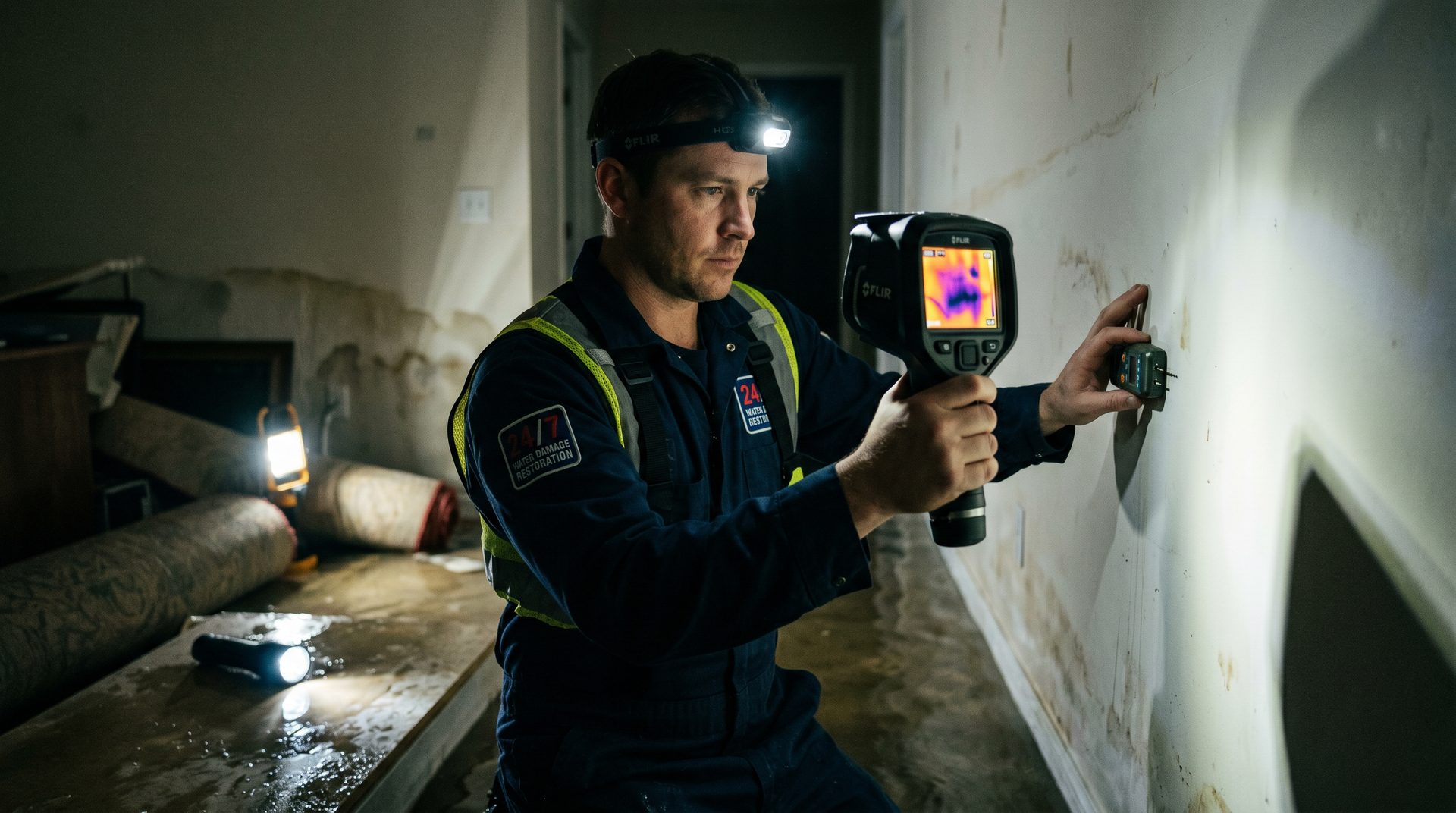
A thermal imaging camera identifies temperature differentials across walls, floors, and ceilings — these reveal moisture behind finished surfaces that would be invisible to visual inspection. Pin and pinless moisture meters quantify moisture content at specific points throughout the affected structure. This moisture map documents the true extent of water migration for your insurance adjuster and forms the baseline against which drying progress is measured.
Phase 3: Water Extraction
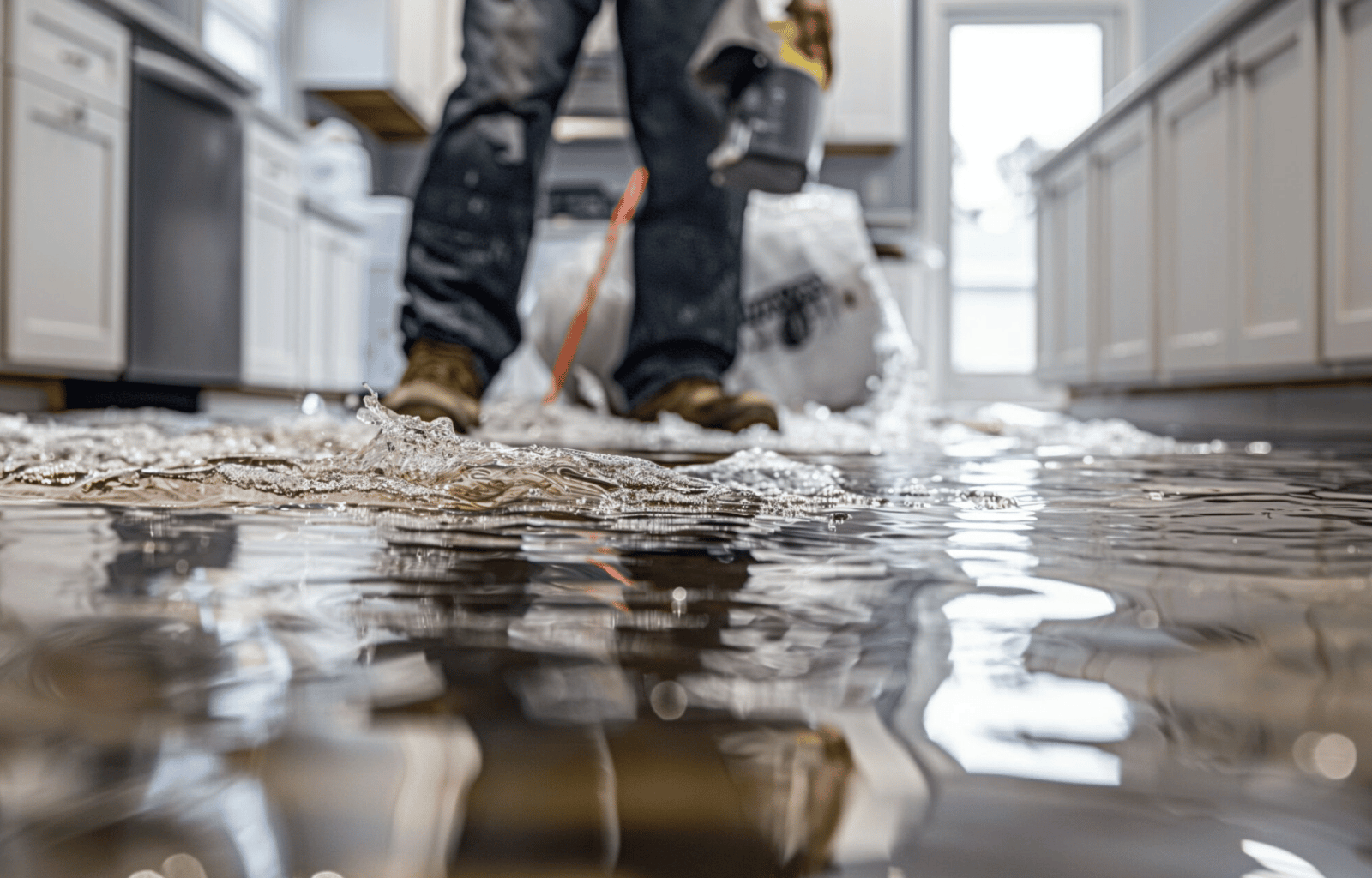
Truck-mounted or high-capacity portable extractors remove standing water. Submersible pumps are deployed for deep basement flooding. Specialty extractors with weighted heads press into carpet and pad to extract water from below the surface layer. Extraction continues until standing water is eliminated from all accessible areas.
Phase 4: Controlled Demolition
Flood cuts in drywall, removal of saturated carpet and pad, and cavity access openings allow drying equipment to reach moisture inside wall assemblies. Flood cuts are typically made at or above the water wicking line — not at the visible water line — because capillary action pulls moisture significantly higher than standing water reached. Insulation batts that have absorbed water are removed, as they cannot be effectively dried in place and become a mold substrate.
Phase 5: Commercial Drying Equipment Deployment
Commercial LGR or desiccant dehumidifiers, air movers, and drying mats are positioned according to a drying plan calibrated to the loss class and affected materials. Consumer-grade fans and rental dehumidifiers cannot achieve the air changes per hour and moisture extraction rates required by IICRC S500 standards. In Calgary's cold-weather conditions, low-temperature-rated desiccant dehumidifiers are required — standard units lose efficiency at low ambient temperatures.
Phase 6: Documentation and Monitoring
All damage is photographed before and after extraction. Daily moisture readings are logged from a consistent grid of measurement points throughout the drying period. The drying log — daily readings from start through target verification — is a required deliverable for your insurance claim and constitutes the professional evidence that drying was completed correctly.
Water Damage Categories and What They Mean for Response
| Category | Source | Health Risk | Response Protocol |
|---|---|---|---|
| Category 1 | Burst supply line, overflowing sink or tub | Low | Standard extraction and drying; no biohazard protocols |
| Category 2 | Washing machine overflow, dishwasher, aquarium | Moderate | Extraction, antimicrobial treatment, drying; PPE required |
| Category 3 | Sewage backup, floodwater, any water sitting 48+ hrs | High — biohazard | Full PPE, all porous material removal, decontamination, health protocols |
Timeline: What to Expect After the Emergency Response
| Phase | Typical Duration |
|---|---|
| Emergency extraction and setup (on day of call) | 2–6 hours |
| Structural drying (commercial equipment running) | 3–7 days (Class 1–2); 7–14 days (Class 3–4 or Category 3) |
| Mold remediation (if required) | 2–5 days active work; additional drying and clearance testing |
| Insurance adjuster assessment | Concurrent with drying — typically day 1–3 |
| Reconstruction | 1–4 weeks depending on scope |
| Total project (standard residential loss) | 2–6 weeks |
Documentation You Should Receive at Project Completion
- Written scope of work — All tasks performed, materials removed, equipment deployed
- Drying log — Daily moisture readings from initial assessment through final verified drying completion
- Pre- and post-intervention photographs — Documenting the condition of all affected areas before work began and after each project phase
- Clearance testing results — If mold remediation was required, the independent environmental consultant's clearance report
- Insurance documentation package — Formatted for submission to your Alberta insurer's adjuster
This documentation package serves as the basis for your insurance claim, protects you in any future dispute, and serves as notice to future home buyers of work performed and the professional standards followed.
Frequently Asked Questions
What should I expect when I call a 24/7 restoration service at 3 AM?
You should reach a live dispatcher — not voicemail — within the first ring or two. The dispatcher takes your loss details, confirms the crew deployment, and provides immediate safety guidance for your specific situation. You should receive a confirmed arrival time. A crew with extraction and drying equipment should arrive within 1–2 hours for most Calgary addresses. If you reach voicemail or are told someone will call back in the morning, that company is not genuinely providing 24/7 emergency response.
How do 24/7 restoration services differ from regular contractors?
Certified restoration companies deploy specialized water extraction equipment, commercial drying systems, and moisture monitoring technology that general contractors do not carry. IICRC-certified technicians are trained in the science of water migration, mold biology, and drying theory — which determines how and where equipment is positioned for effective results. General contractors can perform the reconstruction phase (replacing drywall, flooring, etc.), but the emergency response and drying phases require restoration-specific equipment and expertise to meet the IICRC S500 standard that your insurance adjuster will evaluate the work against.
How much do emergency 24/7 restoration services cost in Calgary?
Emergency water damage mitigation in Calgary typically runs $2,000–$8,000 for the extraction and initial drying phase of a standard residential loss. More extensive losses — large basement floods, sewage backups, or multi-floor events — run $8,000–$20,000+ for mitigation alone, before reconstruction. Most Alberta homeowner's insurance policies cover emergency mitigation services under the covered water damage claim. Keep all invoices and documentation — these are part of your claim submission.
Can I use my insurance company's preferred restoration vendor or choose my own?
In Alberta, you have the right to choose your own restoration contractor. Your insurer may recommend vendors they have working relationships with, but you are not obligated to use them. The key requirements for your insurance claim are that the work is performed by qualified professionals following recognized standards (IICRC S500/S520), that all work is documented, and that the scope is reported to your adjuster before major reconstruction begins. Choosing a company you have vetted for genuine 24/7 capability and IICRC certification is always in your interest regardless of insurer preference.
What is the difference between emergency water extraction and water damage restoration?
Emergency water extraction is the immediate removal of standing water — the first hours of a response. Water damage restoration encompasses the complete process: extraction, structural drying, mold prevention, controlled demolition of damaged materials, and reconstruction to pre-loss condition. Emergency extraction stops the immediate damage; restoration is the full project that returns your home to its prior state. Full-service companies manage both phases under one contract, which is faster and more accountable than separating them.
How do I verify that a Calgary restoration company truly offers 24/7 emergency response?
Call their emergency line now — before you need it. Ask direct questions: Is there a live dispatcher or an answering service? What is the response window to my neighbourhood at 2 AM? How many certified technicians are on call tonight? What equipment comes on the first truck? A company with genuine 24/7 capability answers these questions specifically and confidently. A company using an answering service will route you through a message-taking process. Verify before an emergency, not during one.
What documentation should I receive at the end of an emergency restoration project?
You should receive: a written scope of work specifying all tasks performed and materials removed; a drying log showing daily moisture readings from initial assessment through verified drying completion; photographs documenting pre-intervention condition and post-work condition at each phase; clearance testing results if mold remediation was required; and an insurance documentation package. Any company that cannot provide this complete package at project completion is not operating at the professional standard your property and insurance claim require. Retain all documents with your home records — they may be required by a future home buyer's inspector.
When you're facing water damage at midnight, the most important thing is having a certified team on the way — not an answering service. Our emergency restoration line is live around the clock. Contact us to verify our response capabilities before you need them, or to get immediate help right now.
Easy steps to create a color palette
Lorem ipsum dolor sit amet, consectetur adipiscing elit lobortis arcu enim urna adipiscing praesent velit viverra sit semper lorem eu cursus vel hendrerit elementum morbi curabitur etiam nibh justo, lorem aliquet donec sed sit mi dignissim at ante massa mattis.
- Neque sodales ut etiam sit amet nisl purus non tellus orci ac auctor
- Adipiscing elit ut aliquam purus sit amet viverra suspendisse potent
- Mauris commodo quis imperdiet massa tincidunt nunc pulvinar
- Excepteur sint occaecat cupidatat non proident sunt in culpa qui officia
What is a color palette?
Vitae congue eu consequat ac felis placerat vestibulum lectus mauris ultrices cursus sit amet dictum sit amet justo donec enim diam porttitor lacus luctus accumsan tortor posuere praesent tristique magna sit amet purus gravida quis blandit turpis.

Don’t overspend on growth marketing without good retention rates
At risus viverra adipiscing at in tellus integer feugiat nisl pretium fusce id velit ut tortor sagittis orci a scelerisque purus semper eget at lectus urna duis convallis porta nibh venenatis cras sed felis eget neque laoreet suspendisse interdum consectetur libero id faucibus nisl donec pretium vulputate sapien nec sagittis aliquam nunc lobortis mattis aliquam faucibus purus in.
- Neque sodales ut etiam sit amet nisl purus non tellus orci ac auctor
- Adipiscing elit ut aliquam purus sit amet viverra suspendisse potenti
- Mauris commodo quis imperdiet massa tincidunt nunc pulvinar
- Adipiscing elit ut aliquam purus sit amet viverra suspendisse potenti
What’s the ideal customer retention rate?
Nisi quis eleifend quam adipiscing vitae aliquet bibendum enim facilisis gravida neque euismod in pellentesque massa placerat volutpat lacus laoreet non curabitur gravida odio aenean sed adipiscing diam donec adipiscing tristique risus amet est placerat in egestas erat.
“Lorem ipsum dolor sit amet consectetur adipiscing elit, sed do eiusmod tempor incididunt ut labore et dolore magna aliqua enim ad minim veniam.”
Next steps to increase your customer retention
Eget lorem dolor sed viverra ipsum nunc aliquet bibendum felis donec et odio pellentesque diam volutpat commodo sed egestas aliquam sem fringilla ut morbi tincidunt augue interdum velit euismod eu tincidunt tortor aliquam nulla facilisi aenean sed adipiscing diam donec adipiscing ut lectus arcu bibendum at varius vel pharetra nibh venenatis cras sed felis eget.